The Democrats are convinced that they are going to win big in November.
I predict otherwise.
Most of the Democrats' hopefulness is based on George Bush's approval poll numbers. Democrats forget that Bush is not up for re-election. They also forget that Bush's poll numbers don't mean a thing if their numbers are not any better. And they have consistently failed to turn Bush's sinking poll numbers into rising numbers in their column.
For many months, the unveiling of the Democrats agenda for the future of America has been as imminent as the indictment of Karl Rove. They assure us that they will have figured out what they believe any day now, one of these months. What is clear is that they still have not learned the lessons of the past.
They keep pushing the failed policies of the Great Society, with a firm belief that prosperity comes from pouring more money into more government programs. But government can not make a country innovative or industrious. Higher taxes, more bureaucracy, and increased entitlement spending will not spur our economy on to create more and better jobs. More regulation and a higher tax burden on businesses will not promote entrepreneurialism, the driving force behind our nation's greatness. America is not the strongest nation on earth because of our government. We achieved our current stature because of the private sector and the hard work of our people, and we did it in spite of government. The best thing that our government can do is get out of the way and let Americans do what we do best. But Democrats don't understand that. Their policies are based on the assumption that government is the only solution to any problem, and that you can tax a nation to prosperity.
Democrats also believe that if you are nice to terrorists, they will go away. This was the policy during the eight years of Clinton. When terrorists bombed the World Trade Center, attacked the USS Cole, or bombed our military barracks and embassies, President Clinton got on television and bit his lower lip. Then he vowed to find the people responsible for this awful crime and bring them to justice. But in the end, Clinton spent more money and resources going after Bill Gates than he did going after terrorists. His response was more like the investigation of a crime scene than engagement in a war. The only concrete action was the bombing of an aspirin factory and blowing up a few tents. Our appeasement paid off on 9/11 when they crashed airliners into the World Trade Center and Pentagon. But Democrats still have not learned. They want to go back to Clintonesque policies, leave the terrorists alone, bury our heads in the sand, and hope that Bin Laden and his crew will be touched by our kindness and stop trying to kill us.
So the Democrats will lose in November, because they offer nothing. They count on the rest of the country hating George Bush as much as they do. The only thing they offer the voting public is that "I'm not George Bush." But when people begin to compare the Democrats to George Bush, they will find solid and consistent leadership from Bush and nothing but name calling and triangulation from the Democrats. Most of the voters will see through the Democrats ploy, and in the end, the big win that the Left has been salivating for will not happen.
If you think that you liberal co-worker was devastated by the death of Zarqawi, just wait for November 8.
Thursday, June 15, 2006

Thursday, June 08, 2006
Sincere Condolences
I offer my sincere condolences to all liberal Democrats and their propoganda branch, the mainstream media, who today have lost a brother in their struggle against President George Bush.
Monday, June 05, 2006
What tax rate are we paying?
One of my handful of faithful readers had a question about my "Productivity Curve" concept. He wanted to know what our current tax rate is. He said that he pays a lot less than 33% in taxes.
He probably pays more than he thinks.
We all pay layers and layers of different taxes to the federal government, state government, and local government. Some are direct and others are indirect. Some are visible and some are hidden. My Federal income tax bill is also quite a bit less than 33% of my income. It is somewhere around 10%. But adding up all of the taxes that I pay is a daunting task. The payroll taxes for Medicare and Social Security are about 15%. My property tax bill each year is also quite large. It is not determined as a percentage of my income, but if it was, it would be another 6% or so. That gets us up to 31%, and we have not started to account for sales tax, gasoline taxes, and all of the other tax expenses passed on to me in the cost of the things I buy.
As an example, when I buy one gallon of gasoline at the current price of $2.75, the government takes 53 cents in direct taxation. 18.3 cents goes to the federal excise tax, and the rest goes to the state. But that is not all. The government imposes 43 different taxes on the import, production, and distribution of gasoline. These costs are passed on to me in higher prices. In all, I pay 73 cents in taxes on every gallon of gasoline I buy. But to pay $2.75 in after-tax dollars, I have to earn significantly more than $2.75. At my total marginal tax rate of 40% (including income tax and payroll tax) I have to earn $4.58 to take home $2.75. So to buy $2.02 worth of gas, I must earn $4.58. The government takes the difference: $2.56. My effective tax rate on the money I earned is 55%.
The tax rate varies widely depending on who earns the money and what they do with it. A lower income person pays a lower income tax rate, but a higher payroll tax rate. They also tend to pay more in sales taxes. A higher income person pays a higher income tax rate and lower payroll tax rate. The tax rate is higher if the money is spent on certain high-tax items. It is lower if the money is invested in a tax-sheltered account.
There is one way to determine the national tax rate, including all direct and indirect taxes, and even future tax liabilities created by deficit spending. Total government spending as a percentage of the size of the economy is the ultimate measure of the tax rate. Whatever the government spends, it takes from the economy in some way: either by direct taxation, by borrowing the money obligating them to take it at a later time, or by printing money and diluting the value of the existing money. Each year the Tax Foundation computes the tax rate using this method, and determines the "Tax Freedom Day". Last year, Tax Freedom Day was April 26, meaning that everything we produce and earn from January 1 to April 25 goes to fund the government. This is a 31.8% tax rate. The highest tax rate since World War II occurred during President Clinton's term, when the tax rate hit 33.6%.
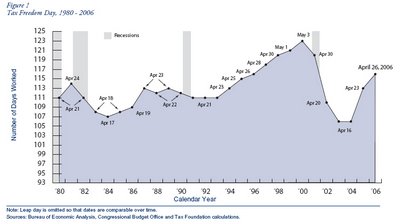
As a whole, our government consumes roughly one third of what the private sector creates. There are other countries with higher tax rates. However, the truth remains that no nation has ever taxed itsself to prosperity. America achieves prosperity in spite of government, not because of it. The best thing that the government can do to increase prosperity is get out of the way.
He probably pays more than he thinks.
We all pay layers and layers of different taxes to the federal government, state government, and local government. Some are direct and others are indirect. Some are visible and some are hidden. My Federal income tax bill is also quite a bit less than 33% of my income. It is somewhere around 10%. But adding up all of the taxes that I pay is a daunting task. The payroll taxes for Medicare and Social Security are about 15%. My property tax bill each year is also quite large. It is not determined as a percentage of my income, but if it was, it would be another 6% or so. That gets us up to 31%, and we have not started to account for sales tax, gasoline taxes, and all of the other tax expenses passed on to me in the cost of the things I buy.
As an example, when I buy one gallon of gasoline at the current price of $2.75, the government takes 53 cents in direct taxation. 18.3 cents goes to the federal excise tax, and the rest goes to the state. But that is not all. The government imposes 43 different taxes on the import, production, and distribution of gasoline. These costs are passed on to me in higher prices. In all, I pay 73 cents in taxes on every gallon of gasoline I buy. But to pay $2.75 in after-tax dollars, I have to earn significantly more than $2.75. At my total marginal tax rate of 40% (including income tax and payroll tax) I have to earn $4.58 to take home $2.75. So to buy $2.02 worth of gas, I must earn $4.58. The government takes the difference: $2.56. My effective tax rate on the money I earned is 55%.
The tax rate varies widely depending on who earns the money and what they do with it. A lower income person pays a lower income tax rate, but a higher payroll tax rate. They also tend to pay more in sales taxes. A higher income person pays a higher income tax rate and lower payroll tax rate. The tax rate is higher if the money is spent on certain high-tax items. It is lower if the money is invested in a tax-sheltered account.
There is one way to determine the national tax rate, including all direct and indirect taxes, and even future tax liabilities created by deficit spending. Total government spending as a percentage of the size of the economy is the ultimate measure of the tax rate. Whatever the government spends, it takes from the economy in some way: either by direct taxation, by borrowing the money obligating them to take it at a later time, or by printing money and diluting the value of the existing money. Each year the Tax Foundation computes the tax rate using this method, and determines the "Tax Freedom Day". Last year, Tax Freedom Day was April 26, meaning that everything we produce and earn from January 1 to April 25 goes to fund the government. This is a 31.8% tax rate. The highest tax rate since World War II occurred during President Clinton's term, when the tax rate hit 33.6%.
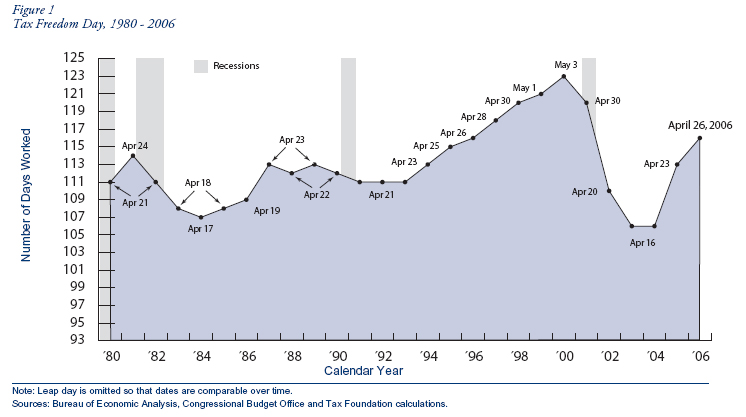
As a whole, our government consumes roughly one third of what the private sector creates. There are other countries with higher tax rates. However, the truth remains that no nation has ever taxed itsself to prosperity. America achieves prosperity in spite of government, not because of it. The best thing that the government can do to increase prosperity is get out of the way.
Thursday, May 25, 2006
The Productivity Curve
The debate about whether we are undertaxed or overtaxed as been raging for decades, and I doubt that I am going to solve it here, but I am going to pour some more fuel on the fire.
The mathematics of economics and tax policy is not an exact science. Any model is bound to be overly simplistic and not take all factors into account. That being said, there are important principles which can be distilled from a mathematical analysis of tax policy.
The Laffer Curve is a concept promoted by economist Arthur Laffer, which shows the relationship between tax rates and tax revenues. It is not intended to be an exact function relating tax revenues to a single variable, but rather, it shows that increasing tax rates does not always increase tax revenues.
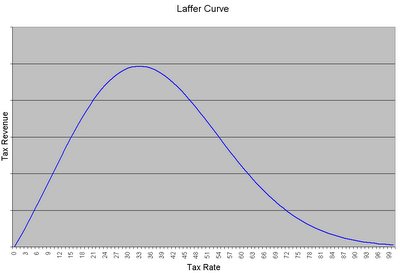 We know that the value of the Laffer Curve is zero at 0% taxation, and we also know that it is zero at 100% taxation. There is not an exact value of the Laffer Curve for all points in between. The tax revenues generated are a function of countless interrelated variables, and tax rate is just one of those determining factors.
While we do not know the exact value of the Laffer Curve, we do know a lot about its shape and properties. It is an arch, skewed towards the lower tax rates. The partial derivative of the Laffer Curve with respect to tax rate is fairly well behaved. In English, this means that if you hold all other factors constant, there is a predictable change in tax revenues resulting from a small change in tax rate. In the example above, a 33% tax rate generates the greatest tax revenues. If the current tax rate is 33%, any change would result in a decrease in tax revenues. If the current tax rate was less than 33%, a small tax increase would increase tax revenues. If the current tax rate was more than 33%, a small tax cut would increase tax revenues.
Remember that the Laffer Curve is not precisely known. In reality, instead of being a single line, it is a band with some thickness, to account for the other factors which affect tax revenues. Instead of having a distinct peak, there is a range which contains the peak, but the precise location of the peak can not be determined because of all of the other factors which affect tax revenues.
There is reason to believe that our current tax rates are close to the peak of the Laffer Curve. This means that Republicans have been successful at achieving their goal of implementing a supply-side economic policy. Democrats argue for a tax rate higher than the rate which maximizes tax revenues. They take this position for reasons that I will go into later.
Republicans have argued for years that tax revenues can be increased by cutting tax rates. This argument was made by President Kennedy when he reduced the top marginal tax rate from 90%, and it was made by President Reagan and President Bush. It has proven to be true in every case. However, I claim that maximizing tax revenues is the wrong goal. Only if you want bigger government and more government and you believe that it is better for the government to spend your money rather than you spending your money should you try to maximize tax revenues. If you recognize that government is too big, too intrusive, and too unproductive, your goal should be to reduce tax revenues and increase private sector productivity.
I suggest that instead of attempting to maximize tax revenues, we should instead maximize productivity. A second curve can be derived directly from the Laffer Curve. I’ll call this the productivity curve. It predicts the relationship between tax rates and productivity of the nation’s economy. It is mathematically certain that the productivity curve peaks at a lower tax rate than the Laffer Curve. For the Laffer Curve to peak, the productivity curve must be sloping steeply downward, indicating that it is past its peak. The standard of living of the country is determined not by tax revenues, but by the production of the economy. Prosperity does not come from the government; it comes from the private sector. If we maximize productivity instead of tax revenues, we will increase our national standard of living.
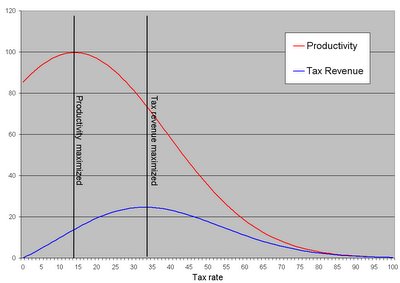 Recognize that the chart above represents the results in a single year. The long-term results look even better for the maximized productivity tax rate. Economic growth is directly related to productivity, maximizing productivity in the current year also increases economic growth for future years because it results in greater reinvestment in the economy. The longer the term you consider, the better the maximized productivity tax rates look. In fact, if you look long term, more tax revenues will be generated by maximizing productivity than by maximizing current tax revenues.
Considering that it is mathematically certain that our nation would be more prosperous if we maximized productivity rather than tax revenues, why have we spent decades chasing after the wrong goal? Primarily it is because we have let the politicians frame the debate. Republicans have argued for a tax policy designed to maximize tax revenues, while claiming to be the party for smaller government. Democrats have taken an even more incomprehensible position, seeking tax rates higher than the rates which maximize revenues. This increases the power of the government, which means that it increases their own power. The further to the right you go on this graph, the larger the share of the economy that the government controls. Liberals believe that government control of the economy is a good thing. This is clearly a self-serving belief for the politicians, but they convince their constituents to buy into that belief by demonizing corporations and business and portraying government as the solution to every problem. By being further to the right on this graph, they give themselves more leverage to buy votes with government money and services, justified in the name of equality.
Neither approach serves the best interests of our nation. Democrats will say that cutting taxes will benefit the rich and increase the gap between the “haves” and the “have-nots”. The reality is that an increase in the prosperity of the country creates more opportunity for anyone to achieve success and share in the prosperity. Democrats don’t like this because it means that they are not the ones providing the wealth redistribution. Government can only transfer wealth. It can not create it. The private sector creates wealth. Government tries to impose equality by changing the way that the “pie” is divided up. The private sector bakes a bigger pie so that everyone can have more without taking it away from someone else. If you prefer the government’s approach, by all means maximize tax revenues. On the other hand, if you prefer unlimited opportunity to equality of outcome, it is time to make major changes to the way we set our tax policy.
The mathematics of economics and tax policy is not an exact science. Any model is bound to be overly simplistic and not take all factors into account. That being said, there are important principles which can be distilled from a mathematical analysis of tax policy.
The Laffer Curve is a concept promoted by economist Arthur Laffer, which shows the relationship between tax rates and tax revenues. It is not intended to be an exact function relating tax revenues to a single variable, but rather, it shows that increasing tax rates does not always increase tax revenues.
 We know that the value of the Laffer Curve is zero at 0% taxation, and we also know that it is zero at 100% taxation. There is not an exact value of the Laffer Curve for all points in between. The tax revenues generated are a function of countless interrelated variables, and tax rate is just one of those determining factors.
While we do not know the exact value of the Laffer Curve, we do know a lot about its shape and properties. It is an arch, skewed towards the lower tax rates. The partial derivative of the Laffer Curve with respect to tax rate is fairly well behaved. In English, this means that if you hold all other factors constant, there is a predictable change in tax revenues resulting from a small change in tax rate. In the example above, a 33% tax rate generates the greatest tax revenues. If the current tax rate is 33%, any change would result in a decrease in tax revenues. If the current tax rate was less than 33%, a small tax increase would increase tax revenues. If the current tax rate was more than 33%, a small tax cut would increase tax revenues.
Remember that the Laffer Curve is not precisely known. In reality, instead of being a single line, it is a band with some thickness, to account for the other factors which affect tax revenues. Instead of having a distinct peak, there is a range which contains the peak, but the precise location of the peak can not be determined because of all of the other factors which affect tax revenues.
There is reason to believe that our current tax rates are close to the peak of the Laffer Curve. This means that Republicans have been successful at achieving their goal of implementing a supply-side economic policy. Democrats argue for a tax rate higher than the rate which maximizes tax revenues. They take this position for reasons that I will go into later.
Republicans have argued for years that tax revenues can be increased by cutting tax rates. This argument was made by President Kennedy when he reduced the top marginal tax rate from 90%, and it was made by President Reagan and President Bush. It has proven to be true in every case. However, I claim that maximizing tax revenues is the wrong goal. Only if you want bigger government and more government and you believe that it is better for the government to spend your money rather than you spending your money should you try to maximize tax revenues. If you recognize that government is too big, too intrusive, and too unproductive, your goal should be to reduce tax revenues and increase private sector productivity.
I suggest that instead of attempting to maximize tax revenues, we should instead maximize productivity. A second curve can be derived directly from the Laffer Curve. I’ll call this the productivity curve. It predicts the relationship between tax rates and productivity of the nation’s economy. It is mathematically certain that the productivity curve peaks at a lower tax rate than the Laffer Curve. For the Laffer Curve to peak, the productivity curve must be sloping steeply downward, indicating that it is past its peak. The standard of living of the country is determined not by tax revenues, but by the production of the economy. Prosperity does not come from the government; it comes from the private sector. If we maximize productivity instead of tax revenues, we will increase our national standard of living.
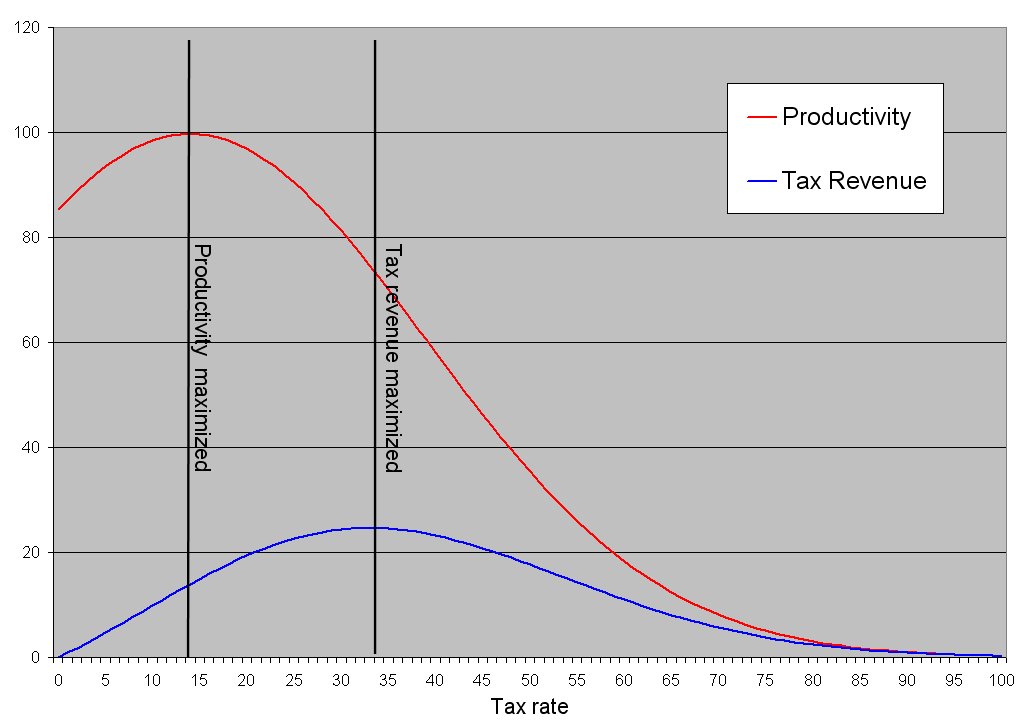 Recognize that the chart above represents the results in a single year. The long-term results look even better for the maximized productivity tax rate. Economic growth is directly related to productivity, maximizing productivity in the current year also increases economic growth for future years because it results in greater reinvestment in the economy. The longer the term you consider, the better the maximized productivity tax rates look. In fact, if you look long term, more tax revenues will be generated by maximizing productivity than by maximizing current tax revenues.
Considering that it is mathematically certain that our nation would be more prosperous if we maximized productivity rather than tax revenues, why have we spent decades chasing after the wrong goal? Primarily it is because we have let the politicians frame the debate. Republicans have argued for a tax policy designed to maximize tax revenues, while claiming to be the party for smaller government. Democrats have taken an even more incomprehensible position, seeking tax rates higher than the rates which maximize revenues. This increases the power of the government, which means that it increases their own power. The further to the right you go on this graph, the larger the share of the economy that the government controls. Liberals believe that government control of the economy is a good thing. This is clearly a self-serving belief for the politicians, but they convince their constituents to buy into that belief by demonizing corporations and business and portraying government as the solution to every problem. By being further to the right on this graph, they give themselves more leverage to buy votes with government money and services, justified in the name of equality.
Neither approach serves the best interests of our nation. Democrats will say that cutting taxes will benefit the rich and increase the gap between the “haves” and the “have-nots”. The reality is that an increase in the prosperity of the country creates more opportunity for anyone to achieve success and share in the prosperity. Democrats don’t like this because it means that they are not the ones providing the wealth redistribution. Government can only transfer wealth. It can not create it. The private sector creates wealth. Government tries to impose equality by changing the way that the “pie” is divided up. The private sector bakes a bigger pie so that everyone can have more without taking it away from someone else. If you prefer the government’s approach, by all means maximize tax revenues. On the other hand, if you prefer unlimited opportunity to equality of outcome, it is time to make major changes to the way we set our tax policy.
Friday, May 19, 2006
The Bible Code
Amidst all of the attention given to the fictional "code" in Dan Brown's fabrication, The Da Vinci Code, another code has gone almost unnoticed.
The Bible, a collection of 66 books writen by dozens of different authors over more than a thousand year's time, contains one cohesive code which runs from beginning to end. The secrets revealed by this amazing code are unknown to most of the world, and carry with them the power to transform lives. To decypher this code, one must analyze a series of ancient symbols arranged according to certain phonetic and grammatical patterns.
Here on this blog I will reveal the secret to break the code and unlock the supernatural power it holds.
First, place a Bible on a table face up, spine to the left. Open the cover to reveal the first page. Carefully examine the text on that page, starting at the upper left and proceeding first from left to right, and from top to bottom. When you reach the end of the first page, turn the page and proceed to the second page. Repeat this process until the secret is revealed.
The Bible, a collection of 66 books writen by dozens of different authors over more than a thousand year's time, contains one cohesive code which runs from beginning to end. The secrets revealed by this amazing code are unknown to most of the world, and carry with them the power to transform lives. To decypher this code, one must analyze a series of ancient symbols arranged according to certain phonetic and grammatical patterns.
Here on this blog I will reveal the secret to break the code and unlock the supernatural power it holds.
First, place a Bible on a table face up, spine to the left. Open the cover to reveal the first page. Carefully examine the text on that page, starting at the upper left and proceeding first from left to right, and from top to bottom. When you reach the end of the first page, turn the page and proceed to the second page. Repeat this process until the secret is revealed.
Monday, May 15, 2006
Dire Warning

Dihydrogen Monoxide (DHMO) is a colorless and odorless chemical compound, also referred to by some as Dihydrogen Oxide, Hydrogen Hydroxide, Hydronium Hydroxide, or simply Hydric acid. Its basis is the unstable radical Hydroxide, the components of which are found in a number of caustic, explosive and poisonous compounds such as Sulfuric Acid, Nitroglycerine and Ethyl Alcohol.
Although the U.S. Government and the Centers for Disease Control (CDC) do not classify Dihydrogen Monoxide as a toxic or carcinogenic substance (as it does with better known chemicals such as hydrochloric acid and benzene), DHMO is a constituent of many known toxic substances, diseases and disease-causing agents, environmental hazards and can even be lethal to humans in quantities as small as a thimbleful.

Research conducted by award-winning U.S. scientist Nathan Zohner concluded that roughly 86 percent of the population supports a ban on dihydrogen monoxide. Although his results are preliminary, Zohner believes people need to pay closer attention to the information presented to them regarding Dihydrogen Monoxide. He adds that if more people knew the truth about DHMO then studies like the one he conducted would not be necessary.
A similar study conducted by U.S. researchers Patrick K. McCluskey and Matthew Kulick also found that nearly 90 percent of the citizens participating in their study were willing to sign a petition to support an outright ban on the use of Dihydrogen Monoxide in the United States.
Each year, Dihydrogen Monoxide is a known causative component in many thousands of deaths and is a major contributor to millions upon millions of dollars in damage to property and the environment. Some of the known perils of Dihydrogen Monoxide are:
 |
|
Despite the known dangers of DHMO, it continues to be used daily by industry, government, and even in private homes across the U.S. and worldwide. Some of the well-known uses of Dihydrogen Monoxide are:

- as an industrial solvent and coolant,
- in nuclear power plants,
- by the U.S. Navy in the propulsion systems of some older vessels,
- by elite athletes to improve performance,
- in the production of Styrofoam,
- in biological and chemical weapons manufacture,
- as a spray-on fire suppressant and retardant,
- in abortion clinics,
- as a major ingredient in many home-brewed bombs,
- as a byproduct of hydrocarbon combustion in furnaces and air conditioning compressor operation,
- in cult rituals,
- by the Church of Scientology on their members and their members' families,
- by both the KKK and the NAACP during rallies and marches,
- by pedophiles and pornographers (for uses we'd rather not say here),
- by the clientele at a number of homosexual bath houses in New York City and San Francisco,
- historically, in Hitler's death camps in Nazi Germany, and in prisons in Turkey, Serbia, Croatia, Libya, Iraq and Iran,
- in World War II prison camps in Japan, and in prisons in China, for various forms of torture,
- by the Serbian military as authorized by Slobodan Milosevic in their ethnic cleansing campaign,
- by many terrorist organizations,
- in community swimming pools to maintain chemical balance,
- in animal research laboratories, and
- in pesticide production and distribution.
|  |

One of the most surprising facts recently revealed about Dihydrogen Monoxide contamination is in its use as a food and produce "decontaminant." Studies have shown that even after careful washing, food and produce that has been contaminated by DHMO remains tainted by DHMO.
Our children are in peril, and we must act now! Contact your Senators and Representatives! Contact the EPA and FDA! Contact the Sierra Club, Earth First, and Al Gore! Let them know that we must end this assault on our health and our environment today! Before it is too late.
Thursday, May 11, 2006
Duh Vinci Code
One of the biggest movies of the summer is sure to be The Da Vinci Code. I read the book, and I could write pages and pages about the mis-information in the book. If you are interested in that, there are plenty of sources which will provide a thorough debunking of the pseudo-historical premise of the book. In the end, it is easier to list the factual content of the book than the misinformation. The facts in Dan Brown's Da Vinci Code can be summarized as follows:
One response is to blame Dan Brown for writing the book, or Hollywood for making the movie. The reality is that these people are simply responding to a need for answers to spiritual questions, and this need exists because the Church is failing to provide those answers. As believers, we are partially to blame for Brown's success at passing off fiction as fact. We, as a group, don't know what we believe and why we believe it, and we are not adequately prepared to offer something better than Brown's myth.
I see this movie not as a cause for outrage, but as an opportunity to address real issues which people struggle with every day. The interest in this book and movie shows that people want to know who God is, who Jesus is, and what He means to their lives. The Church has the only real and lasting way to meet this basic need. The response of the Church will distinguish Christianity from other world religions: we will not take to the street in angry mobs burning cars, hurling stones, and killing people in rage at the perceived indignity. But we must go one step further than simply refraining from these reactions by proclaiming the truth that people are searching for: Jesus offers grace and forgiveness which changes our lives and gives us fellowship with God.
The tag line of the movie is "Seek the truth." If people are willing to honestly seek the truth, I am confident that fiction will be revealed as false, and the truth of the Bible will stand. If this movie causes people to embark on this kind of search, it is a good thing.
But we, the Church, must be ready to address the questions which will arise and help to direct people to the truth of the transforming power of Jesus Christ. Instead of looking for truth in a fictional novel, perhaps they should start in the non-fiction section of the library. Then examine the Bible in the light of historical reality. Most importantly, we need to let them see that Jesus is more than a hisorical figure. He is alive and active in our lives today.
This is how Paul instructed us to respond:
- London is in England
- Paris is in France
- Leonardo Da Vinci was a painter
Some people will defend the book and the movie on the basis that it is a work of fiction, and therefore by definition, is not factual. However, Dan Brown, the author of The Da Vinci Code, on a page right after the title page asserts that "All descriptions of artwork, architecture, documents, and secret rituals are accurate." Thus, from the beginning, the book claims to be more than pure fiction. Brown went to great lengths to muddle fact and fiction, leading readers to believe that the premise of the book is plausible and supported by fact. The following is the most recent review on the Amazon web site. It is typical of many of the other reviews:
Once I began this extraordinary book, I could not put it down. "The Da Vinci Code" is so much more than a gripping suspense thriller. Dan Brown takes us beyond the main plot and leads us on a quest for the Holy Grail - a Grail totally unlike anything we have been taught to believe. With his impeccable research, Mr. Brown introduces us to aspects and interpretations of Western history and Christianity that I, for one, had never known existed...or even thought about. I found myself, unwillingly, leaving the novel, and time and time again, going online to research Brown's research - only to find a new world of historic possibilities opening up for me. And my quest for knowledge and the answers to questions that the book poses, paralleled, in a sense, the quest of the book's main characters. What a trip! What a read!People are looking to this fictional work in their search for truth. It is a sad sign of our times that people will accept a novel as their source of truth, but we should not be surprised. The Apostle Paul said that this would happen:
For the time will come when they will not endure sound doctrine; but wanting to have their ears tickled, they will accumulate for themselves teachers in accordance to their own desires, and will turn away their ears from the truth and will turn aside to myths. (II Timothy 4:3-4)
One response is to blame Dan Brown for writing the book, or Hollywood for making the movie. The reality is that these people are simply responding to a need for answers to spiritual questions, and this need exists because the Church is failing to provide those answers. As believers, we are partially to blame for Brown's success at passing off fiction as fact. We, as a group, don't know what we believe and why we believe it, and we are not adequately prepared to offer something better than Brown's myth.
I see this movie not as a cause for outrage, but as an opportunity to address real issues which people struggle with every day. The interest in this book and movie shows that people want to know who God is, who Jesus is, and what He means to their lives. The Church has the only real and lasting way to meet this basic need. The response of the Church will distinguish Christianity from other world religions: we will not take to the street in angry mobs burning cars, hurling stones, and killing people in rage at the perceived indignity. But we must go one step further than simply refraining from these reactions by proclaiming the truth that people are searching for: Jesus offers grace and forgiveness which changes our lives and gives us fellowship with God.
The tag line of the movie is "Seek the truth." If people are willing to honestly seek the truth, I am confident that fiction will be revealed as false, and the truth of the Bible will stand. If this movie causes people to embark on this kind of search, it is a good thing.
But we, the Church, must be ready to address the questions which will arise and help to direct people to the truth of the transforming power of Jesus Christ. Instead of looking for truth in a fictional novel, perhaps they should start in the non-fiction section of the library. Then examine the Bible in the light of historical reality. Most importantly, we need to let them see that Jesus is more than a hisorical figure. He is alive and active in our lives today.
This is how Paul instructed us to respond:
Preach the word; be ready in season and out of season; reprove, rebuke, exhort, with great patience and instruction. ... But you, be sober in all things, endure hardship, do the work of an evangelist, fulfill your ministry. (II Timothy 4: 2,5)Let's not miss the opportunity that this movie provides, but use every opportunity to let the light of Jesus shine. When we present the truth to the world, they won't need to look to pulp fiction pretending to be fact for their answers.
Monday, May 08, 2006
CBS News hires Moussaoui
(05-08-2006) CBS News today announced plans for convicted terror conspirator Zacarias Moussaoui to take the place of Dan Rather as anchor of their evening news. It was unclear when Moussaoui, who "defeated" America by being sentenced to spend the rest of his life in a concrete room instead of dying by lethal injection, would be available to perform his anchor duties.
CBS President Arnold Harbinger said, "Mr. Moussaoui is an ideal replacement for Dan Rather because the two share many common interests, viewpoints, ideologies, and delusions of self-importance. Both exhibit the zeal to advance these viewpoints, using unconventional methods when necessary. Mr. Moussaoui's improvised identification documents prove that he is up to the high standard set by Dan Rather. And we believe that Mr. Moussaoui will bring depth and balance to our news desk. The 'wave the white flag, cut and run, appease the terrorists' crowd is already well represented, and CBS is a bit thin in the 'kill Americans and destroy the Zionist Satan' department."
In related news, an audio tape has surfaced in which Osama Bin Laden can be heard, speaking from his subterranean headquarters, expressing gratitude to America for sparing the life of Moussaoui, and repealing the murder of 3,000 Americans on 9/11 as a token of his new appreciation for the American justice system.
CBS President Arnold Harbinger said, "Mr. Moussaoui is an ideal replacement for Dan Rather because the two share many common interests, viewpoints, ideologies, and delusions of self-importance. Both exhibit the zeal to advance these viewpoints, using unconventional methods when necessary. Mr. Moussaoui's improvised identification documents prove that he is up to the high standard set by Dan Rather. And we believe that Mr. Moussaoui will bring depth and balance to our news desk. The 'wave the white flag, cut and run, appease the terrorists' crowd is already well represented, and CBS is a bit thin in the 'kill Americans and destroy the Zionist Satan' department."
In related news, an audio tape has surfaced in which Osama Bin Laden can be heard, speaking from his subterranean headquarters, expressing gratitude to America for sparing the life of Moussaoui, and repealing the murder of 3,000 Americans on 9/11 as a token of his new appreciation for the American justice system.
Thursday, April 20, 2006
Financial planning
I have been interested in investments and finances for a long time. I have read enough and studied enough to manage my own investments more effectively than a professional financial planner could do, and much less expensively. I have written my own portfolio optimization program and designed an improved system for portfolio distribution. I am well versed in the theory and mathematics of asset allocation, Modern Portfolio Theory, Efficient Market Hypothesis, and various equity pricing models. But occasionally something comes along which revolutionizes the way that I look at finances. When it does, I will pass it along to you, the handful of readers of this blog.
The revolution is a new way of doing lifetime financial planning: consumption smoothing. Larry Kotlikoff, professor of Economics at Boston University, used this concept to create the most comprehensive financial planning tool available today, Economic Security Planner. At $200 it is not cheap, but compared to the ongoing cost of hiring a financial planner and paying his loads, commissions, and fees for the rest of your life, it is a bargain. And the value of the advice from ESP is likely to be far greater than from a member of the financial industry sales force.
The principles behind consumption smoothing are not new. They have been studied by economists for decades. But until now, the computing power and software required to apply the theory to an individual family's financial situation did not exist. Considerations such as the impact of taxes, social security, and uncertain future investment returns make the problem very computationally intensive. Conventional financial planners use one-size-fits-all rules of thumb which typically do more to pad the planner's pocketbook with larger commissions than to serve the needs of the customer. Being off by even a few percent can cost thousands of dollars over your lifetime.
The concept is simple: to create a plan which avoids sudden large changes in standard of living. These changes could take many forms: reaching retirement age without enough in savings to maintain your previous standard of living, or reaching retirement with way more money than you need, encountering large expenses like college costs without enough money saved, or the death of a spouse. ESP helps an individual create a lifetime financial plan including things like:
The revolution is a new way of doing lifetime financial planning: consumption smoothing. Larry Kotlikoff, professor of Economics at Boston University, used this concept to create the most comprehensive financial planning tool available today, Economic Security Planner. At $200 it is not cheap, but compared to the ongoing cost of hiring a financial planner and paying his loads, commissions, and fees for the rest of your life, it is a bargain. And the value of the advice from ESP is likely to be far greater than from a member of the financial industry sales force.
The principles behind consumption smoothing are not new. They have been studied by economists for decades. But until now, the computing power and software required to apply the theory to an individual family's financial situation did not exist. Considerations such as the impact of taxes, social security, and uncertain future investment returns make the problem very computationally intensive. Conventional financial planners use one-size-fits-all rules of thumb which typically do more to pad the planner's pocketbook with larger commissions than to serve the needs of the customer. Being off by even a few percent can cost thousands of dollars over your lifetime.
The concept is simple: to create a plan which avoids sudden large changes in standard of living. These changes could take many forms: reaching retirement age without enough in savings to maintain your previous standard of living, or reaching retirement with way more money than you need, encountering large expenses like college costs without enough money saved, or the death of a spouse. ESP helps an individual create a lifetime financial plan including things like:
- How much should I save?
- How much should I put in my 401k?
- How much can I spend this year without putting my future in jeopardy?
- How much life insurance should I have?
- What asset allocation should I use?
- Will I be able to pay for my kid's college?
- When can I afford to retire?
- What should I do now to minimize the impact of taxes over my lifetime?
- What are my priorities for saving?
- Will my family be secure if I die?
Without something like ESP, you are left to guess at the answers to these questions, and being off by even a small amount can result in big financial disruptions in the future. ESP is the most comprehensive tool available to individuals to help them make these important decisions.
For a full discussion of consumption smoothing and ESP, read this paper by Kotlikoff.
(I do not profit in any way from the sale of this product. All disclaimers apply.)
Tuesday, April 18, 2006
Global warming
There is terrible news for environmentalists today.
Global warming has apparently stopped.
The official temperature records stored at the University of East Anglia shows that the average global temperature has not increased in the past 8 years. Global warming stopped in 1998. From 1970 until 1998, the average global temperature increased by almost 2 degrees Fahrenheit. However, in the past 8 years, the temperature has dropped a fraction of a degree.
The really horrible news for environmentalists is that in those same eight years, human production of “greenhouse gases” such as carbon dioxide was at its highest levels ever. Our factories, power plants, and SUVs continued to pump more carbon dioxide into the atmosphere than ever before, and yet the "human caused" warming trend reversed.
Even before this latest example, there was plenty of evidence that there is no correlation between human activity and the temperature cycles of the earth. A previous warming cycle occurred from 1918 until 1940, well before the major increase of "greenhouse gas" emissions, and the following cooling cycle lasting from 1940 and 1965 coincided precisely with the period of greatest increase in emissions worldwide. Environmentalists love to make wild claims such as "This is the hottest year since 1500!" And what made 1500 so hot? Was it the Hummers and the coal-burning power plants? Was it caused by Republicans not signing on to the Kyoto Treaty? Perhaps Christopher Columbus was to blame, because we know that it is always a European American, and he is the closest thing there was to a European American at the time.
You would think that environmentalists would be overjoyed to discover that humans are not causing global warming, that the earth has natural temperature cycles, and that we are not on the brink of a worldwide cataclysm caused by American industry. But they are not. In fact, they are more hysterical than ever. They point to their computer models which say that by the year 2030 the global temperature will have increased by 6 degrees. Or 2 degrees. Or 1 degree. It depends which model you look at, how you set all of the very sensitive parameters, and who you ask. They won't tell you that in 1990 those same models were saying that by 2005 the global temperature would have climbed by three degrees. Nor will they tell you that in 1970 those same models said that by 1990 the global temperature would have dropped by six degrees, sending the earth into an ice age. That's right, thirty-five years ago the environmentalist panic was over global cooling caused by American industry. The only thing which has stayed the same is the identity of the villain.
So why are environmentalists so sad to hear that we are not all about to die as a result of global warming? It is because their power comes from the imminent threat of crisis. Looming disaster is their excuse to enact their real agenda, which is greater government control over industry. The environment is just an excuse to accomplish a liberal coup, seizing more power for the government and putting more of the economy under their control. If the earth is not about to be destroyed by evil corporations burning fossil fuels and building gas-guzzling SUVs, the impetus for more government regulation and greater socialization is gone. And worse yet, the opportunity to use fear mongering to increase their fundraising is dangerously threatened. If their global warming pseudo-science is debunked, how will they be able to write hysterical fund-raising letters convincing concerned people to send in $50 or face certain demise from melting polar caps?
The real crisis here has nothing to do with carbon dioxide, shrinking ozone layer, melting polar ice, or global warming. The crisis which has the left in a tizzy is the shrinking and melting away of their power and influence as people recognize them as the frauds they are.
Global warming has apparently stopped.
The official temperature records stored at the University of East Anglia shows that the average global temperature has not increased in the past 8 years. Global warming stopped in 1998. From 1970 until 1998, the average global temperature increased by almost 2 degrees Fahrenheit. However, in the past 8 years, the temperature has dropped a fraction of a degree.
The really horrible news for environmentalists is that in those same eight years, human production of “greenhouse gases” such as carbon dioxide was at its highest levels ever. Our factories, power plants, and SUVs continued to pump more carbon dioxide into the atmosphere than ever before, and yet the "human caused" warming trend reversed.
Even before this latest example, there was plenty of evidence that there is no correlation between human activity and the temperature cycles of the earth. A previous warming cycle occurred from 1918 until 1940, well before the major increase of "greenhouse gas" emissions, and the following cooling cycle lasting from 1940 and 1965 coincided precisely with the period of greatest increase in emissions worldwide. Environmentalists love to make wild claims such as "This is the hottest year since 1500!" And what made 1500 so hot? Was it the Hummers and the coal-burning power plants? Was it caused by Republicans not signing on to the Kyoto Treaty? Perhaps Christopher Columbus was to blame, because we know that it is always a European American, and he is the closest thing there was to a European American at the time.
You would think that environmentalists would be overjoyed to discover that humans are not causing global warming, that the earth has natural temperature cycles, and that we are not on the brink of a worldwide cataclysm caused by American industry. But they are not. In fact, they are more hysterical than ever. They point to their computer models which say that by the year 2030 the global temperature will have increased by 6 degrees. Or 2 degrees. Or 1 degree. It depends which model you look at, how you set all of the very sensitive parameters, and who you ask. They won't tell you that in 1990 those same models were saying that by 2005 the global temperature would have climbed by three degrees. Nor will they tell you that in 1970 those same models said that by 1990 the global temperature would have dropped by six degrees, sending the earth into an ice age. That's right, thirty-five years ago the environmentalist panic was over global cooling caused by American industry. The only thing which has stayed the same is the identity of the villain.
So why are environmentalists so sad to hear that we are not all about to die as a result of global warming? It is because their power comes from the imminent threat of crisis. Looming disaster is their excuse to enact their real agenda, which is greater government control over industry. The environment is just an excuse to accomplish a liberal coup, seizing more power for the government and putting more of the economy under their control. If the earth is not about to be destroyed by evil corporations burning fossil fuels and building gas-guzzling SUVs, the impetus for more government regulation and greater socialization is gone. And worse yet, the opportunity to use fear mongering to increase their fundraising is dangerously threatened. If their global warming pseudo-science is debunked, how will they be able to write hysterical fund-raising letters convincing concerned people to send in $50 or face certain demise from melting polar caps?
The real crisis here has nothing to do with carbon dioxide, shrinking ozone layer, melting polar ice, or global warming. The crisis which has the left in a tizzy is the shrinking and melting away of their power and influence as people recognize them as the frauds they are.
Monday, April 17, 2006
Happy Tax Day
It's Tax Day, so I want you to stop and ask yourself one question:
Are you getting your money's worth?
Are you getting your money's worth?
Wednesday, April 12, 2006
Socialist Space Exploration
Forty years ago today, the first man orbited the earth in a primitive, Russian space capsule.
Twenty five years ago today, the first Space Shuttle lifted off from Florida and went into orbit.
Back in those days, if you asked where our space program would be in 2006, the answer would have been mind-blowing. By 2006, we were told, we would have cities in orbit, permanently manned bases on the moon, human exploration of Mars, and at least the beginnings of a manned interstellar program. Space travel, we were promised, would be as routine as flying from New York to London.
Our space program has failed to deliver on that early promise. It seems that the height of our achievement was the Apollo program more than thirty years ago. We could not send a man back to the moon today if we wanted to. The Space Shuttle program has never been as successful as we hoped. It was originally touted as being capable of flying ten to fifteen missions a year, but five missions in a year is the most it has ever achieved. The plans for the International Space Station are getting more modest each year, as the program slides further behind schedule and over budget.
So what is the cause of this lack of innovation or progress?
We have turned space exploration into another ineffective government program, blocking our greatest engine of innovation, the free market private sector, from reaching its full potential in advancing the technology of space flight. The same principle is true in space flight as anywhere else: the best and brightest people don't work for the government. If they did, the private sector would hire them away. NASA is crippled by the fact that it is government run, and thus not propelled by the market forces which fuel private enterprise. Instead, it is limited by the short-sighted nature of public funding and the whim of Congress. The private sector should, in theory, be far better than the government at developing new technology to achieve our goals in space. But there is not a single American company which provides a commercial satellite launch capability. Several companies have tried, but none have succeeded. It is not that the technical challenge is beyond the ability of American industry. We built rockets which could carry a satellite to orbit decades ago. The reason that there is no private sector business flying in space is that it is not economically feasible. To break into the business, a company would have to compete with NASA, a taxpayer subsidized entity. NASA can offer their satellite launching service at a lower price because they are funded by the government, and there is no way that a private company can compete with that. By maintaining a government-run space program, we not only have a sub-par space program, but we also block out private companies which could do a lot more if they could break into the industry.
So let's get back to the vision we had forty years ago, get the government out of the way, and unleash America's unstoppable creativity and the power of free market enterprise to reach our Space Age dreams.
Twenty five years ago today, the first Space Shuttle lifted off from Florida and went into orbit.
Back in those days, if you asked where our space program would be in 2006, the answer would have been mind-blowing. By 2006, we were told, we would have cities in orbit, permanently manned bases on the moon, human exploration of Mars, and at least the beginnings of a manned interstellar program. Space travel, we were promised, would be as routine as flying from New York to London.
Our space program has failed to deliver on that early promise. It seems that the height of our achievement was the Apollo program more than thirty years ago. We could not send a man back to the moon today if we wanted to. The Space Shuttle program has never been as successful as we hoped. It was originally touted as being capable of flying ten to fifteen missions a year, but five missions in a year is the most it has ever achieved. The plans for the International Space Station are getting more modest each year, as the program slides further behind schedule and over budget.
So what is the cause of this lack of innovation or progress?
We have turned space exploration into another ineffective government program, blocking our greatest engine of innovation, the free market private sector, from reaching its full potential in advancing the technology of space flight. The same principle is true in space flight as anywhere else: the best and brightest people don't work for the government. If they did, the private sector would hire them away. NASA is crippled by the fact that it is government run, and thus not propelled by the market forces which fuel private enterprise. Instead, it is limited by the short-sighted nature of public funding and the whim of Congress. The private sector should, in theory, be far better than the government at developing new technology to achieve our goals in space. But there is not a single American company which provides a commercial satellite launch capability. Several companies have tried, but none have succeeded. It is not that the technical challenge is beyond the ability of American industry. We built rockets which could carry a satellite to orbit decades ago. The reason that there is no private sector business flying in space is that it is not economically feasible. To break into the business, a company would have to compete with NASA, a taxpayer subsidized entity. NASA can offer their satellite launching service at a lower price because they are funded by the government, and there is no way that a private company can compete with that. By maintaining a government-run space program, we not only have a sub-par space program, but we also block out private companies which could do a lot more if they could break into the industry.
So let's get back to the vision we had forty years ago, get the government out of the way, and unleash America's unstoppable creativity and the power of free market enterprise to reach our Space Age dreams.
Thursday, April 06, 2006
Welfare crisis

In March, 2006 the number of New York City residents on the welfare rolls fell to the lowest level since December of 1964.
Today there are about 402,000 New York City residents on welfare, down nearly two thirds from the high point during Clinton's administration.
Is this good news or bad news? That depends entirely on your perspective.
If you are a liberal who measures compassion based on the number of people dependant on government assistance, this is a crisis of epic proportions. In fact, it is a threat to that which matters most to you in this world: your chances to gain power in the next election.
If you are a conservative who measures compassion based on the number of people who no longer need government assistance, it is very good news.
But how are her document forging skills
Katie Couric will have big shoes to fill as she takes over the CBS anchor job.
She certainly has years of experience reading a teleprompter, so that should not be an issue.
And she has well established liberal credentials, which is a basic qualification for the job.
However, there is no reason to think that she is up to the critical task of forging documents to create news stories damaging to conservatives. Without this skill, CBS News will just not be the same.
She certainly has years of experience reading a teleprompter, so that should not be an issue.
And she has well established liberal credentials, which is a basic qualification for the job.
However, there is no reason to think that she is up to the critical task of forging documents to create news stories damaging to conservatives. Without this skill, CBS News will just not be the same.
Wednesday, April 05, 2006
A challenge
So the fact that we have not found the chemical weapons which we know that Saddam had is proof that they don't exist?
Here is a challenge:
Give me five years and a $10 million budget to hide one hundred 50-gallon barrels anywhere in the state of Texas. During those five years, you can observe from England or Canada.
At the end of the five years, you will have three years to find the barrels. During that time, I will have a few thousand people shooting at you as you search.
Oh, I forgot to mention that I have the option of hiding the barrels in Oklahoma or New Mexico, but you can't look for them there.
If you don't find the barrels in three years, we can conclude that they don't exist, right?
Here is a challenge:
Give me five years and a $10 million budget to hide one hundred 50-gallon barrels anywhere in the state of Texas. During those five years, you can observe from England or Canada.
At the end of the five years, you will have three years to find the barrels. During that time, I will have a few thousand people shooting at you as you search.
Oh, I forgot to mention that I have the option of hiding the barrels in Oklahoma or New Mexico, but you can't look for them there.
If you don't find the barrels in three years, we can conclude that they don't exist, right?
Monday, April 03, 2006
Seen on monster.com
Wanted
White House seeking new director for Federal Emergency Management Agency.
Must desire to be held responsible for the ignorant behavior of every individual during the next hurricane, flood, tornado, terrorist attack, fire, cartoon snubbing Islam, or Cubs loss in the World Series. Job includes being held accountable for the failure of local emergency responders to do their job. Signing bonus is a 100% cotton t-shirt with the phrase "Designated Fall Guy" embroidered on the front in large script lettering.
Please hurry. Hurricane season begins in just two months.
White House seeking new director for Federal Emergency Management Agency.
Must desire to be held responsible for the ignorant behavior of every individual during the next hurricane, flood, tornado, terrorist attack, fire, cartoon snubbing Islam, or Cubs loss in the World Series. Job includes being held accountable for the failure of local emergency responders to do their job. Signing bonus is a 100% cotton t-shirt with the phrase "Designated Fall Guy" embroidered on the front in large script lettering.
Please hurry. Hurricane season begins in just two months.
Organs
Every year in America, thousands of people die while they wait for an organ donation which never comes. At the same time, hundreds of thousands of people die with perfectly good organs which could save lives, but are not used.
China has a solution to this problem. There are more than enough organs available in China, and many people go to China to buy organs which they can't get in other places. China gets these organs by killing people accused of political or religous crimes and taking their organs.
Other countries mandate that organs be harvested from anyone who dies with useable organs.
In America, we don't do things that way. We believe in freedom and individual rights, not tyranny or total government control. A person's organs belong to that person, and can not be taken away against that person's will. But there is something we can do to eliminate the shortage of organs.
Allow individuals to leave their organs to their estate.
The estate could then sell the organs at a price determined by the free market. This would encourage people to allow their organs to be used, because it would benefit their own family in addition to benefiting the organ recipient.
Some might object to this based on the idea that it would make organs unaffordable. The reality is that it would not. Organs are already sold at market price, only now the company who harvests the organs pockets the money generated. What claim does that company have on the value of the organ? They should be compensated for the cost of harvesting the organ, but the organ itsself belongs to the donor. The price for organs is determined by supply and demand. If the supply increases, the price will decrease.
Other people might have ethical problems with the idea of a person selling his organs to benefit his estate. The company which currently sells the organs doesn't have an ethical problem with that. They profit handsomely from it. But your organs belong to you. They are your property. The definition of ownership includes the right to sell your property. If you own your organs, there is no ethical problem with selling them after you die. There is a much greater ethical problem with burying the organs in the ground and letting someone who needed those organs die.
This is a win-win proposition. It allows an individual to help their own family and help someone in need of a new organ at the same time.
China has a solution to this problem. There are more than enough organs available in China, and many people go to China to buy organs which they can't get in other places. China gets these organs by killing people accused of political or religous crimes and taking their organs.
Other countries mandate that organs be harvested from anyone who dies with useable organs.
In America, we don't do things that way. We believe in freedom and individual rights, not tyranny or total government control. A person's organs belong to that person, and can not be taken away against that person's will. But there is something we can do to eliminate the shortage of organs.
Allow individuals to leave their organs to their estate.
The estate could then sell the organs at a price determined by the free market. This would encourage people to allow their organs to be used, because it would benefit their own family in addition to benefiting the organ recipient.
Some might object to this based on the idea that it would make organs unaffordable. The reality is that it would not. Organs are already sold at market price, only now the company who harvests the organs pockets the money generated. What claim does that company have on the value of the organ? They should be compensated for the cost of harvesting the organ, but the organ itsself belongs to the donor. The price for organs is determined by supply and demand. If the supply increases, the price will decrease.
Other people might have ethical problems with the idea of a person selling his organs to benefit his estate. The company which currently sells the organs doesn't have an ethical problem with that. They profit handsomely from it. But your organs belong to you. They are your property. The definition of ownership includes the right to sell your property. If you own your organs, there is no ethical problem with selling them after you die. There is a much greater ethical problem with burying the organs in the ground and letting someone who needed those organs die.
This is a win-win proposition. It allows an individual to help their own family and help someone in need of a new organ at the same time.
Wednesday, March 29, 2006
Limousine Liberals
Liberals like to pose as the champion of the little guy.
They claim to be the ones who are in tune with the blue collar worker.
They sympathize with the plight of the downtrodden.
They stand up for those who are exploited by evil corporations.
But occasionally, one of these big-hearted liberals slips up and reveals what he really thinks.
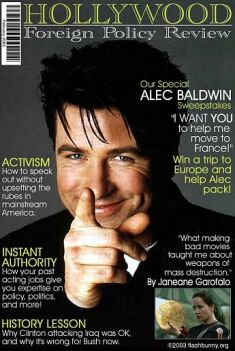
On Sunday night, Hollywood actor Alec Baldwin was co-hosting a radio program with Brian Whitman on WABC in New York. He made some disparaging remarks about Sean Hannity, and Mr. Hannity called in to discuss the remarks. Alec Baldwin, who has publicly called Vice President Cheney a terrorist and suggested that Henry Hyde be stoned to death, was not willing to defend his comments with substance. Instead, he immediately launched a personal attack against Sean Hannity. The actor searched for the deepest, darkest, most demeaning insult that he could conjure up, and he came up with this gem:
"Why would I want to come on the show with a no-talent, former construction worker hack like you? "
In a single sentence, Alec Baldwin revealed what he truly thinks of real Americans. Construction workers are the people who make America work. We all depend on them for the houses we live in, the buildings where we work, shop, and live out our lives, and the roads we drive on. Baldwin shows the height of his arrogance and condescension by using "construction worker" as an insulting epithet. He believes that his career of pretending to be someone not only makes him better than the rabble who pay admission to his films, but also makes his opinions more valid and more important than anyone else's. The fact that Baldwin thinks that calling someone a "former construction worker" is an insult reflects much more on Baldwin than on the target of Baldwin's diatribe.
Although Baldwin's self-importance has not yet reached the level of Richard Gere, who claimed to speak for the entire world, it is getting close.
They claim to be the ones who are in tune with the blue collar worker.
They sympathize with the plight of the downtrodden.
They stand up for those who are exploited by evil corporations.
But occasionally, one of these big-hearted liberals slips up and reveals what he really thinks.
On Sunday night, Hollywood actor Alec Baldwin was co-hosting a radio program with Brian Whitman on WABC in New York. He made some disparaging remarks about Sean Hannity, and Mr. Hannity called in to discuss the remarks. Alec Baldwin, who has publicly called Vice President Cheney a terrorist and suggested that Henry Hyde be stoned to death, was not willing to defend his comments with substance. Instead, he immediately launched a personal attack against Sean Hannity. The actor searched for the deepest, darkest, most demeaning insult that he could conjure up, and he came up with this gem:
"Why would I want to come on the show with a no-talent, former construction worker hack like you? "
In a single sentence, Alec Baldwin revealed what he truly thinks of real Americans. Construction workers are the people who make America work. We all depend on them for the houses we live in, the buildings where we work, shop, and live out our lives, and the roads we drive on. Baldwin shows the height of his arrogance and condescension by using "construction worker" as an insulting epithet. He believes that his career of pretending to be someone not only makes him better than the rabble who pay admission to his films, but also makes his opinions more valid and more important than anyone else's. The fact that Baldwin thinks that calling someone a "former construction worker" is an insult reflects much more on Baldwin than on the target of Baldwin's diatribe.
Although Baldwin's self-importance has not yet reached the level of Richard Gere, who claimed to speak for the entire world, it is getting close.
Tuesday, March 28, 2006
Making it all worthwhile
Sometimes something happens which makes it all worthwhile.
Yesterday, my wife was talking with our 6-year-old son. He was telling her about how he was going to have eight boys when he grows up. He told her that he would need a big house for all of those kids.
My wife said, "You'd better work hard in school so that you can get a good job. You need to be able to support that family, and you don't want your wife to have to work and put the kids in day care."
My son said, "What is day care?"
At that moment, all of the effort we have made to be sure that one or the other of us is always available to be with the kids paid off. We could live in a fancier house, drive a nicer car, and have a bigger checking account, and get more sleep if we dumped the kids in day care while we both went to work. But what is the point of having kids if you are going to hire someone to raise them? Investment in things which last and things which really matter will always pay off.
Yesterday, my wife was talking with our 6-year-old son. He was telling her about how he was going to have eight boys when he grows up. He told her that he would need a big house for all of those kids.
My wife said, "You'd better work hard in school so that you can get a good job. You need to be able to support that family, and you don't want your wife to have to work and put the kids in day care."
My son said, "What is day care?"
At that moment, all of the effort we have made to be sure that one or the other of us is always available to be with the kids paid off. We could live in a fancier house, drive a nicer car, and have a bigger checking account, and get more sleep if we dumped the kids in day care while we both went to work. But what is the point of having kids if you are going to hire someone to raise them? Investment in things which last and things which really matter will always pay off.
Friday, March 03, 2006
Real Westerns
I used to watch the Academy Awards, or at least I was interested enough to find out who won. I watched two years ago when the third Lord of the Rings movie swept most of the categories. I will not be watching this year. Politics have taken over the Academy, and people are voting to prove how "enlightened" they are, rather than based on the quality of the films.
Brokeback Mountain is a perfect example of this. The Actor's Screen Guild was right in passing it up, but it will almost certainly win a bunch of Oscars on Sunday. Personally, I much preferred Crash for best picture. If you have not seen it, I highly recommend it. Joaquin Phoenix would get my vote for best actor, for his role in Walk the Line. And why didn't Russell Crowe even get a best actor nomination for Cinderella Man?
One positive note is that Brokeback Mountain was not nominated for best documentary, even though the equally fictitious "Bowling for Columbine" won that category two years ago, again based on politics rather than merit.
Brokeback Mountain is not the only nomination which reveals Hollywood's political agenda. Other nominated films show a gay writer as a soulful artist, a transsexual as a responsible parent, a Palestinian suicide bomber as a thoughtful, conscience-driven activist, greedy oil company executives as, well, greedy oil company executives, and Senator Joe McCarthy as (gasp) a threat to American civil liberties. Positive representations of Christians, conservatives, or white hetersexuals are strangely missing.
Brokeback Mountain is popular in Hollywood because it is an attack on the American history of the west as a place of rugged individualism where the men are, well, manly. Although I am not a big fan of westerns, I love the distinctly American culture they reflect. I plan to spend Sunday evening celebrating the American West by watching a true, red-blooded American Western. I have not decided on which one to watch yet, but my prime candidates are: True Grit, The Shootist, The Man Who Shot Liberty Valance, The Treasure of the Sierra Madre, or Red River.
Brokeback Mountain is a perfect example of this. The Actor's Screen Guild was right in passing it up, but it will almost certainly win a bunch of Oscars on Sunday. Personally, I much preferred Crash for best picture. If you have not seen it, I highly recommend it. Joaquin Phoenix would get my vote for best actor, for his role in Walk the Line. And why didn't Russell Crowe even get a best actor nomination for Cinderella Man?
One positive note is that Brokeback Mountain was not nominated for best documentary, even though the equally fictitious "Bowling for Columbine" won that category two years ago, again based on politics rather than merit.
Brokeback Mountain is not the only nomination which reveals Hollywood's political agenda. Other nominated films show a gay writer as a soulful artist, a transsexual as a responsible parent, a Palestinian suicide bomber as a thoughtful, conscience-driven activist, greedy oil company executives as, well, greedy oil company executives, and Senator Joe McCarthy as (gasp) a threat to American civil liberties. Positive representations of Christians, conservatives, or white hetersexuals are strangely missing.
Brokeback Mountain is popular in Hollywood because it is an attack on the American history of the west as a place of rugged individualism where the men are, well, manly. Although I am not a big fan of westerns, I love the distinctly American culture they reflect. I plan to spend Sunday evening celebrating the American West by watching a true, red-blooded American Western. I have not decided on which one to watch yet, but my prime candidates are: True Grit, The Shootist, The Man Who Shot Liberty Valance, The Treasure of the Sierra Madre, or Red River.
Subscribe to:
Posts (Atom)
