Last week, the voters fired the Republican Congress.
If we try to read the election any other way, we will reach the wrong conclusions.
We can't whitewash it or pretend that it didn't happen. If we don't figure out why it happened and make significant changes, it will take a very long time to recover.
On the other hand, the election was not a vote FOR the Democrats. They did not present a clear platform or communicate a direction for the country, so they can not claim any kind of a mandate for their agenda. This was purely a vote AGAINST Bush and the Republican Congress.
It is vital that Republican's correctly interpret the message we got from the voters and make the correct changes.
First of all, we should not mistake it as a push to become more liberal. Many of the Democrats who were elected were conservatives. There was not a liberal ideological move in the nation which brought about this change in the control of Congress. It would be more accurate to say that the Republican Party moved to the left of it's core supporters, the voters responsible for electing Reagan in 1980 and a Republican majority in 1994.
It is also wrong to dismiss the election as purely a statement against the war in Iraq or support for Murtha's plan to abandon Iraq. Joe Lieberman, a strong supporter of victory in Iraq, was elected by a wide margin, rejecting an anti-war Democrat alternative. Some voters were expressing their view that we should not have gone to war in Iraq. That is a valid view, and one which I expressed back in January of 2003. Today 20/20 hindsight is not very relevant, because we must deal with the reality that we are at war in Iraq. But I do think that the election was a demand for improved results in Iraq. We need a better strategy for victory in Iraq, not to redefine surrender as victory. I am eager to see Baker's recommendations, and I would embrace a plan which results in a stable, democratic ally in Iraq.
After studying the results of exit polls on the issues driving this election, it becomes clear that there are several things Republicans must do to regain momentum. When CNN asked voters what issues were most important, Iraq was forth on the list, behind corruption, terrorism, and the economy. Exit polling found that voters trusted Democrats more than Republicans on the issues of taxes and spending. Up until two years ago, this position would have been completely unjustified, but today it is quite understandable.
Corruption in the Republican Party is a serious issue which needs to be addressed. As taxpayers and citizens we should not put up with it. Democrats are certainly not immune from corruption, as evidenced by William Jefferson and his deep freeze full of cash. But the party in control is always going to more prone to corruption, because they have more influence. Democrats have created the perception that corruption is a Republican issue, and capitalized on that perception very successfully. As Republicans we need to do a much better job of keeping our house clean so that we will be above reproach and don’t give our opponents the opportunity to undermine our effort.
Terrorism ought to be a winning issue for Republicans. Democrats are pathetically weak in defending our nation and responding to terrorists actions. We saw Clinton’s way of dealing with terror, and there is a clear distinction in the decisive way that President Bush has responded. This is a case where we just need to stay on message and communicate the distinction without allowing Democrats to turn a positive into a negative.
Republicans won control of Congress in 1994 on a platform of limited government, controlled spending, and tax cuts. Newt Gingrich became the torch bearer for the Reagan Revolution. For six years they governed according to these principles, and the result was a large reduction in the deficit and a strong, growing economy. However, when George Bush became President, it broke the gridlock and resulted in an inexcusable spending binge. The principles on which the Reagan Revolution was built were quickly forgotten. On this blog, I have been hollering about fiscal responsibility and controlling spending, but no one, not even our representatives in Washington DC, is really listening.
In my view, the point where we lost was when we switched from being principle driven to politically driven. We need a leader who is more like Ronald Reagan or Newt Gingrich and less like Karl Rove. I am not yet ready to single out one person as that leader, but Mitt Romney or Newt would be candidates.
There was a clear message sent last Tuesday. We need to listen, respond, and move forward.
Monday, November 13, 2006

Wednesday, November 08, 2006
Silver lining
We always try to keep an upbeat outlook, so I have gone out of my way to find the positive side to the Democrats taking control of the House of Representatives. There are a few very definite upsides:
- The New York Times and CNN will have much more favorable coverage of Congress
- Rhode Island Republican Lincoln Chafee lost, and Connecticut Democrat Joe Lieberman won. That is a net gain of two for the GOP.
- We finally get to see the Democrat's plan for victory in Iraq.
- Taxpayers will be relieved of the stress of making so many investment decisions.
- Reduction in attacks on our troops in Iraq, since terrorists fear attorneys.
- Pennsylvania Senator Rick Santorum is now available for Supreme Court appointment.
- NSA agents could soon be freed from having to listen to annoying terrorist chatter.
- Since a lot of the polling places are in church buildings, millions of Democrats actually went to church yesterday.
- Democrats can sleep more peacefully, now that they know that Karl Rove does not control everything.
Friday, November 03, 2006
Republicans in a funk
Polls indicate that Republican voters are feeling hopeless and depressed by the course of the nation. Mired by relentless barrage of painful publicity of plunging gasoline prices, record stock market levels, reduced tax rates and surging tax revenues, and the Bush administration's failure to produce inflation despite the lowest unemployment rate in more than fiave years, Republicans believe that it could not get any worse. Meanwhile, Democrats ride a wave of public adoration due to the party's clear, positive vision for protecting the civil rights of foreign terrorists, retreating from Iraq so that the rival Muslim sects can work out their differences without American interference, and a return to the Clinton-era "spirit of cooperation" with North Korea.
Thursday, November 02, 2006
Kerry blames GOP for botched apology

Senator John Kerry today issued a statement on his web page blaming Republicans for misunderstanding his botched attempt at an apology for his remarks about the intellectual capacity of American soldiers:
“As a combat veteran, I want to make it clear to anyone in uniform and to their loved ones: my poorly stated joke at a rally was not about, and never intended to refer to any troop. I sincerely regret that my words were misinterpreted to wrongly imply anything negative about those in uniform, and I personally apologize to any service member, family member, or American who was offended.“
The junior senator from Massachusetts said that “in the course of my botched apology, I inadvertently used the word ‘troop’ to refer an individual soldier. I also said that I ‘personally apologize’ when in reality I just posted a few sentences on my web site, addressed to no one in particular.”
“Come to think of it,” he continued, “my apology didn’t admit wrong doing, express regret for my actions, or offer to make things right. I really just blamed the troops for being dumb enough to misunderstand the nuance of my joke.”
“It has been suggested that the context of my remarks should be considered. After all, I did take a cheap dig at the President earlier in the speech, and it is unlikely that I would just take a shot at our troops out of the blue. Of course, in the bigger context of my life, insulting the American military is a favorite pastime of mine. My comments about uneducated failures getting stuck in Iraq is just a reprise of my old anti-Vietnam shtick, which is the cornerstone of my political career.”
“The true significance of my botched apology is that Republicans will do anything to divert attention from the quagmire in Iraq, even if it means letting a Democrat Senator scuttle his party’s political strategy on the eve of national elections.”
Wednesday, November 01, 2006
Kerry pays respect

To all of our troops fighting bravely around the world, standing up against the forces of evil and terror who hate America and the freedom it represents, John Kerry salutes you.
Here is what the Democrat's 2004 Presidential Candidate had to say:
“You know, education, if you make the most of it, you study hard, you do your homework and you make an effort to be smart, you can do well. If you don’t, you get stuck in Iraq.”
John Kerry, who I must remind you, voted FOR the war (before voting to defund our troops who were already there) supports you, even though you are stupid highschool flunk-out losers who have no better career prospects than terrorizing women and children in the dark of night.
It's good to know you are appreciated, huh?
Monday, October 30, 2006
Feeling over thinking
A week ago, actor Michael J Fox appeared in television ads supporting Claire McCaskill's campaign for Senator from Missouri. There has been a great deal of controversy over the ads, in which Fox makes a number of factually untrue claims, including a charge that Senator Talent, McCaskill's opponent, wants to make stem-cell research illegal. The truth is that stem cell research is legal and is already happening in Missouri and across the country. The major difference between McCaskill and Talent is that McCaskill wants to provide federal funding for embryonic stem cell research, and Talent thinks that it should be privately funded.
Most scientists (other than those lobbying for tax dollars to support embryonic stem cell research) agree that adult stem cells and umbilical stem cells are much more promising candidates to achieve effective treatments for Parkinson's Disease and spinal cord injuries. Embryonic stem cells are just one of many varieties of stem cells being researched, and are the least promising in terms of the prospects for actually curing diseases. While other kinds of stem cells are already in use for the treatment of at least 80 different conditions, embryonic stem cells have not even been approved for a single human clinical trial, mainly due to the high risk of rejection and the side affect of causing monster tumors observed in animal trials. However, the majority of Democrats in Congress voted earlier this year to fund embryonic stem cell research, but voted against funding the more promising research involving stem cells which do not require the death of the donor. It seems that they only want research if it requires that unborn babies be killed in the process. And thus the real agenda is revealed: federal funding of embryonic stem cell research is a desperate attempt to demonstrate that there is a benefit to society in the killing of unborn babies.
I said from the beginning that the Fox ad plays to people's emotions, rather to rational thought. Rush Limbaugh was broadly criticized when he suggested that Fox stopped taking his Parkinson's medicine to film the ads, but Fox wrote in his book that he intentionally stopped his medication when testifying before Congress. It is clear that he is using his symptoms to invoke an emotional reaction of sympathy. It comes across as a shameless act of manipulation, and you have to wonder if he thinks that people are really stupid enough to fall for it.
You might think that Fox's condition makes him uniquely qualified to speak on efforts to cure Parkinson's Disease. Surely he is more knowledgeable about the issues in the Missouri election than the average guy. The central issue revolves around a ballot proposition which provides funding for embryonic stem cell research in Missouri. Its supporters point out that the proposition forbids human cloning. While it does forbid reproductive cloning, it explicitly protects the practice of human cloning for research: the process of farming cloned human embryos expressly for the purpose of using the embryos for research. When Fox was asked about this on ABC's "This Week" he said something rather remarkable:
Most scientists (other than those lobbying for tax dollars to support embryonic stem cell research) agree that adult stem cells and umbilical stem cells are much more promising candidates to achieve effective treatments for Parkinson's Disease and spinal cord injuries. Embryonic stem cells are just one of many varieties of stem cells being researched, and are the least promising in terms of the prospects for actually curing diseases. While other kinds of stem cells are already in use for the treatment of at least 80 different conditions, embryonic stem cells have not even been approved for a single human clinical trial, mainly due to the high risk of rejection and the side affect of causing monster tumors observed in animal trials. However, the majority of Democrats in Congress voted earlier this year to fund embryonic stem cell research, but voted against funding the more promising research involving stem cells which do not require the death of the donor. It seems that they only want research if it requires that unborn babies be killed in the process. And thus the real agenda is revealed: federal funding of embryonic stem cell research is a desperate attempt to demonstrate that there is a benefit to society in the killing of unborn babies.
I said from the beginning that the Fox ad plays to people's emotions, rather to rational thought. Rush Limbaugh was broadly criticized when he suggested that Fox stopped taking his Parkinson's medicine to film the ads, but Fox wrote in his book that he intentionally stopped his medication when testifying before Congress. It is clear that he is using his symptoms to invoke an emotional reaction of sympathy. It comes across as a shameless act of manipulation, and you have to wonder if he thinks that people are really stupid enough to fall for it.
You might think that Fox's condition makes him uniquely qualified to speak on efforts to cure Parkinson's Disease. Surely he is more knowledgeable about the issues in the Missouri election than the average guy. The central issue revolves around a ballot proposition which provides funding for embryonic stem cell research in Missouri. Its supporters point out that the proposition forbids human cloning. While it does forbid reproductive cloning, it explicitly protects the practice of human cloning for research: the process of farming cloned human embryos expressly for the purpose of using the embryos for research. When Fox was asked about this on ABC's "This Week" he said something rather remarkable:
"I don't think that's true. ... I have to qualify it by saying I'm not qualified to speak on the page-to-page content of the initiative. Although, I am quite sure that I'll agree with it in spirit, I don't know. On full disclosure, I haven't read it, and that's why I didn't put myself up for it distinctly."So Michael J Fox admits that he made an ad supporting a candidate because of her position on an initiative which he has not even bothered to read! If there is any question that this ad campaign is pure emotional manipulation, rather than an appeal to rational thought, this puts it to rest.
Thursday, October 26, 2006
Speaker Pelosi

The election is 12 days away, and Nancy Pelosi, the San Francisco Treat, is already picking out the curtains for her new Speaker of the House Office Suite. But what will America look like if Nancy Pelosi has her way? Does it really matter if the Democrats take over Congress? The Republicans have plenty of faults. I have taken issue with them repeatedly for not controlling spending. And they could have done a lot better at communicating the rationale behind the War on Terror and the importance of winning in Iraq. But for all of their shortcomings, they are light-years better than the Democrats.
Here are some things to think about:
- Do you want to see more good judges like Roberts and Alito confirmed? Elect Democrats and they will block confirmation of anything but liberal activist judges.
- Do you think you pay enough in taxes, or do you feel the need to pay even more? Nancy Pelosi and many other Democrats have said that a top priority is reversing President Bush’s cuts to every tax bracket.
- Do you really think that Democrats will do better on controlling spending? All historical evidence suggests the opposite.
- Do you want homosexual marriage legalized? Vote Democrat! That is one of Pelosi’s biggest issues, being a San Francisco liberal.
- Do you want human cloning legalized and funded by your tax dollars? What about harvesting human embryos for research? Democrats have politicized this issue, but they only support research if it involves killing babies. They voted against supporting much more productive research involving adult stem cells.
- Do you support amnesty for illegal immigrants? Bills to take important steps to secure our borders have been held up because Democrats and a handful of “moderate” Republicans demand giving amnesty to people in the country illegally.
- Do you think that appeasement and negotiation is the best way to deal with rogue dictators, terrorists, and nations which support terrorists? President Clinton gave North Korea a nuclear reactor in return for assurances to use it only to generate energy. Guess where the weapons-grade uranium in bomb they tested came from?
- Do you think that President Clinton’s approach to terror was more effective than President Bush’s? Clinton’s response to attacks on the World Trade Center, the USS Cole, the American Embassies in Kenya and Tanzania, and the Marine barracks in Saudi Arabia was to give a speech, bite his lower lip, and vow to bring the people responsible to justice. The extent of his action was to blow up an aspirin factory in Afghanistan. Bush has dismantled Al Qaida’s command structure and crippled their ability to operate. The final measure of his success is seen in the fact that in the five years since 9/11 Al Qaida has not been able to carry out another attack on American soil.
- Do you think that someone should be able to take underage girls to another state for an abortion without her parent’s knowledge? Pelosi has said that she supports repeal of a law requiring parental notification to take a minor child across state lines for an abortion.
- Do you want to hamstring our efforts to stop terror attacks? Pelosi bragged about killing the Patriot Act, which gives critical tools to our Homeland Security Department.
- Do you want to confer Constitutional rights on terrorists? Democrats want to give known terrorists public trials with the same high standard of proof required of criminal trials. This will result in known terrorists being turned free to continue their murder.
- Do you think that Democrats have a better plan for how to win in Iraq? What is it? They criticize President Bush, call our troops terrorists, and say that we can’t win, but they don’t have an alternative plan to offer, other than Jack Murtha’s cut and run, surrender to the terrorists.
- Do you think that we should intercept the communications of terrorists when they call people in the United States? Democrats want to make it prohibitively difficult.
- Do you want our military to surrender Iraq to the terrorists? Although there is a lot of debate among Democrats about what to call this, very few Democrats are committed to winning in Iraq, supporting the new government until it becomes self-sustaining. Those like Lieberman who do understand the importance of finishing the job are punished by the left wing of the party as an example to other Democrats.
- Do you think that President Bush should be impeached over policy differences in the War on Terror? Representative John Conyers , the ranking Democrat in the House Judiciary Committee, has already circulated a document intended as the basis of impeachment hearings.
Do you think that there is no difference between the Republicans and Democrats? Think again.
Do you think that Democrats have earned the right to govern? How?
Do you think that issue by issue, Democrats are better than Republicans?
If you don’t want to go where the Democrats want to take us, go vote and take a friend!
Thursday, October 19, 2006
That's it!
I've heard enough! There is no place in Congress for a sleaze like Mark Foley. As Republicans, we will not tolerate someone like Foley exchanging explicit emails with underage pages. We are not like the Democrats who allowed Gerry Studds to not only remain in Congress but to be committee chairman for 13 more years AFTER it was discovered that he was having sex with a 17-year-old page. We have higher standards than that. We will not allow Foley to make a mockery of Congress by remaining in office. I call on Mark Foley to resign immediately!
Monday, October 16, 2006
Call me Jack
There is just no way that the Republicans are going to win this election, so we might as well just give up now. What is the point in even going to the polls to vote? Let's just write this one off and hand the country over to the Democrats. In fact, Republicans in Congress might as well just resign now. I call for a full and immediate redeployment of Republican politicians back into the private sector. Why stop with Congress? President Bush should just go ahead and resign too. While we are at it, let's just suspend all future elections, and have Bill Clinton appoint whoever he wants to run the country. We got into this election for the wrong reasons, and we were mislead into thinking that it would be easy to win. This is an election that we simply can not win. In fact, we have already lost it, so why should we keep dragging out the pain? I say we should cut and run, surrender, wave the white flag, give up. Why maintain the illusion that there is still hope? I volunteer to help Hillary pick out her new curtains for the Oval Office.
Wednesday, October 11, 2006
The Don Factor
- Lucent stock increased 613% from 1997 to 2000 and then dropped 99% from 2000 to 2002
- Lockheed stock dropped 71% from 1997 to 2000 andthen grew 412% from 2000 to 2002

There is clearly a turning point for both companies at January of 2000. What happened at that point in time?
In January of 2000, Don moved from Lucent to Lockheed.
The impact shook Wall Street.
Lucent's astronomical growth turned into a nosedive.
Lockheed's floundering was reversed and the stock took off like an F-16.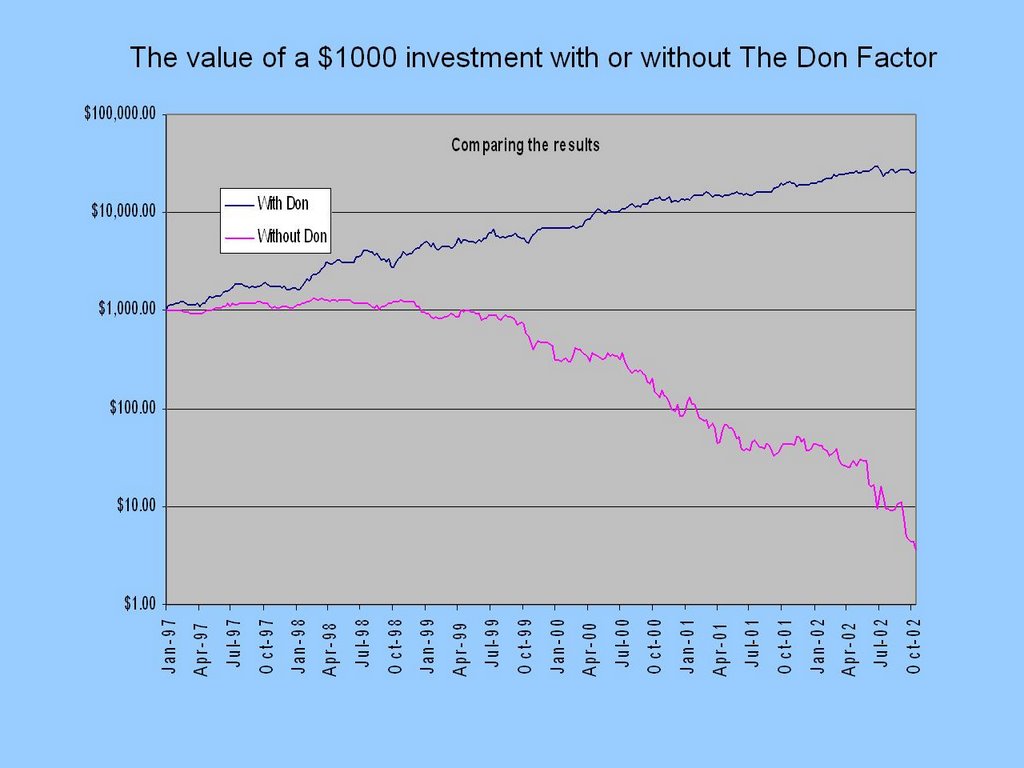
This suggests a new investment approach:
Invest in the company where Don works.
- If you invested $1000 in Lucent when Don worked there, and then moved the money to Lockheed when Don moved, in six years, your $1000 investment would have grown to $26,230.
- If you invested $1000 in Lockheed when Don worked at Lucent and then moved the money to Lucent when Don moved to Lockheed, your $1000 investment would have shrunk to $3.62 by the end of 2002.
Don’s total impact on the market accounts for $233 billion in market movement.
Conclusion: Don is underpaid.
Tuesday, October 10, 2006
Two approaches
There are two approaches to dealing with murderous dictator thugs. One is to use diplomacy, negotiation, appeasement, and concessions to encourage them to do the right thing. For decades we have used this approach with North Korea. President Clinton gave them the nuclear reactor they are using to create the uranium to make nuclear bombs, in the hopes that they would use it for peaceful purposes. While diplomacy is the right approach to dealing with responsible nations, the fruits of years of diplomacy, compromises, and negotiation were seen yesterday when North Korea tested a nuclear weapon, the latest act in their effort to extort more money from us with their nuclear blackmail.
The other approach is to confront evil dictators head-on and prevent them from reaching a point where they can threaten the world with nuclear weapons. Here is something to ponder: has Saddam Hussein tested a nuclear weapon? Do you think that he will test a nuclear weapon next year? What about next decade? Will Iraq EVER threaten to nuke Israel if we don’t send them another twenty billion dollars in foreign aid? Did we avoid this threat by appeasing Saddam? No! We reached this point by strong military action. In 1981, Israel bombed the heck out of Saddam’s Osirak reactor, preventing them from using it to enrich uranium to make a nuclear bomb. Estimates are that Iraq could have produced one or more bombs by 1988 if that reactor had remained in operation. Then in 1991 we again set their nuclear program back a decade or more with our bombing campaign in the Gulf War. Finally, in 2003 we ousted Saddam, captured him, and put him in jail. We know that he had weapons of mass destruction under his control in the past. He used them no less than a dozen times, and he repeatedly tried to obtain a nuclear capability. We know that today he does not have weapons of mass destruction under his control, and he will never hold the world hostage with nuclear blackmail. It seems that this approach is much more effective. Maybe it is time to reconsider how we deal with Kim Jong-il.
The other approach is to confront evil dictators head-on and prevent them from reaching a point where they can threaten the world with nuclear weapons. Here is something to ponder: has Saddam Hussein tested a nuclear weapon? Do you think that he will test a nuclear weapon next year? What about next decade? Will Iraq EVER threaten to nuke Israel if we don’t send them another twenty billion dollars in foreign aid? Did we avoid this threat by appeasing Saddam? No! We reached this point by strong military action. In 1981, Israel bombed the heck out of Saddam’s Osirak reactor, preventing them from using it to enrich uranium to make a nuclear bomb. Estimates are that Iraq could have produced one or more bombs by 1988 if that reactor had remained in operation. Then in 1991 we again set their nuclear program back a decade or more with our bombing campaign in the Gulf War. Finally, in 2003 we ousted Saddam, captured him, and put him in jail. We know that he had weapons of mass destruction under his control in the past. He used them no less than a dozen times, and he repeatedly tried to obtain a nuclear capability. We know that today he does not have weapons of mass destruction under his control, and he will never hold the world hostage with nuclear blackmail. It seems that this approach is much more effective. Maybe it is time to reconsider how we deal with Kim Jong-il.
Monday, October 09, 2006
Amish Funeral Protests
Yesterday morning I gathered with about five hundred people at Hulen Street Baptist Church. We sang praises to the Lord, prayed, and heard God's Word proclaimed. All across the nation, others were doing the same thing. Tens of millions of believers united their hearts in the unity which can only come from a relationship with Jesus Christ. Lives were transformed, broken relationships were healed, hearts were cleansed. The course of people's lives were reversed, turning from a downward spiral away from God to a full, purposeful life in God's will. Countless people accepted Jesus free gift of eternal life and began to experience the abundant life that God intended for them.
In Nickel Mines Pennsylvania, about 20 members of a fringe "church" from Topeka Kansas threatened to picket at the funeral of the five Amish girls killed in the school shooting last week. The protestors, from a church which was asked to leave the Southern Baptist Convention many years ago because of their un-Christlike rhetoric and methods, never actually showed up to picket.
But if you based your opinion of Christians on this weekend's media coverage, what picture would you get: people living out a renewed life in relationship with their creator and redeemer, or angry people invading the privacy of people suffering from a horrible tragedy?
The reality of the Christian life as experienced by me and by tens of millions of other believers is not deemed newsworthy. After all, it happens every day in every city and town. Every channel on your 200-channel cable box could not contain all of the stories of what an extraordinary God is doing in normal people's lives. But all you get from the media is coverage of a few nutcases who use this kind of tragedy to get attention for themselves through their outrageously inappropriate actions.
The media’s job is to report the unusual events, the exceptions, the fringe occurrences, not the common things which happen all the time. That is our job. On Sunday mornings we gather together in the church building, but on Monday morning, the Church of Jesus Christ hits the road. We carry the light of Jesus into our homes, communities, schools, workplaces, hospitals, grocery stores, and wherever else we go. A darkened and lost world needs to see that light in us, in our actions and our words, because they are surely not going to get it from watching TV.
In Nickel Mines Pennsylvania, about 20 members of a fringe "church" from Topeka Kansas threatened to picket at the funeral of the five Amish girls killed in the school shooting last week. The protestors, from a church which was asked to leave the Southern Baptist Convention many years ago because of their un-Christlike rhetoric and methods, never actually showed up to picket.
But if you based your opinion of Christians on this weekend's media coverage, what picture would you get: people living out a renewed life in relationship with their creator and redeemer, or angry people invading the privacy of people suffering from a horrible tragedy?
The reality of the Christian life as experienced by me and by tens of millions of other believers is not deemed newsworthy. After all, it happens every day in every city and town. Every channel on your 200-channel cable box could not contain all of the stories of what an extraordinary God is doing in normal people's lives. But all you get from the media is coverage of a few nutcases who use this kind of tragedy to get attention for themselves through their outrageously inappropriate actions.
The media’s job is to report the unusual events, the exceptions, the fringe occurrences, not the common things which happen all the time. That is our job. On Sunday mornings we gather together in the church building, but on Monday morning, the Church of Jesus Christ hits the road. We carry the light of Jesus into our homes, communities, schools, workplaces, hospitals, grocery stores, and wherever else we go. A darkened and lost world needs to see that light in us, in our actions and our words, because they are surely not going to get it from watching TV.
Tuesday, October 03, 2006
What do you say?
Imagine for a moment that you are standing in front of a stadium packed with twenty thousand people, and they are not happy with you. They all have one thing in common: each one lost a spouse, sibling, child, or parent when terrorists blew up the Liberty Tower in LA, the tallest skyscraper on the west coast.
You were responsible for gathering intelligence from 9/11 mastermind Khalid Sheikh Mohammed after he was captured in March of 2003 in Pakistan. This Al Qaeda leader, already responsible for the deaths of three thousand Americans, had vital knowledge about no fewer than nine terror plots in various stages of planning, and had information which could lead to the arrest of dozens of terrorists around the world.
But Khalid was not willing to share that information freely. He held out against standard interrogation methods such as sleep deprivation and prolonged exposure to cold.
There was one more technique available to you: waterboarding. In this interrogation method, the subject is strapped to a board and positioned with his feet slightly above his head. A cloth is wrapped tightly around his face, and water is poured over his head, creating the sensation of asphyxiation. While this may cause great distress, it is harmless when conducted properly. CIA members routinely practice this technique on each other, and most people give in to the demands of the interrogator is less than a minute.
You, however, decided that it would not be morally acceptable to use this interrogation technique with Khalid Sheikh Mohammed. After all, in America we take the high road, and waterboarding the man who conceived the idea of 9/11 would make us morally equivalent to Khmer Rouge, Hitler, Idi Amin, or Saddam, evil dictators who tortured, mutilated, and killed people in their quest to torture, mutilate, and kill more people.
As a result, the information which could have prevented the attack on the Liberty Tower remained locked inside of the head of one of the most evil men alive.
You are about to address the family members of those who were killed. What will you say to them? How will you justify your decision? How will you make the case that it was better for their loved ones to be murdered than to subject Khalid Sheikh Mohammed to two minutes of agony? How will you convince these people that it was morally superior to assure the comfort of a terrorist than to protect the lives of innocent Americans? Come on! What are you going to say?
Fortunately, this scenario is only in our imagination. In the real world, a defiant Khalid held out against many other interrogation techniques, until as a last resort they proceeded to waterboarding. Two minutes into the procedure, a broken Mohammed begged for relief. His extensive confession led to the thwarting of a number of terror plots (including the imminent operation to blow up Liberty Tower) and the capture of dozens of terrorists in many different countries. Mohammed’s case was not unusual in how quickly it worked. It was unusual for how long Mohammed was able to withstand it. Most terrorists break down in half that time. It is not known exactly how often waterboarding is employed, but it has been made known that it has worked every time it has been tried. Information obtained in this way has led to the capture of numerous terrorists and the prevention of many deadly plots, saving an untold number of lives.
The claim that waterboarding is unethical does not hold up to closer scrutiny. To illustrate this, let us contrast waterboarding to the most common approach which involved prolonged sleep deprivation combined with exposure to cold. This can take days or weeks to break the captive down to the point of giving up the desired information, often resulting in long-term physical or psychological trauma. And even then it is much more likely that the subject, given that much time to consider his options, will provide false or misleading information. Waterboarding, on the other hand, lasts for a few fleeting minutes, and carries the least risk of long-term harm. Not only is it more effective, it is also the most humane.
A form of mercy is extended to the murderous terrorist which he would not extend to his innocent victims: the anguish is stopped the moment he expressed a desire for it to be so. While the terrorist seeks to commit horrendous acts of mass murder, leaving as many mangled corpses behind as possible, waterboarding permits the terrorist to live to see another day, unscathed by his momentary ordeal. But it provides us the intelligence we urgently need to save innocent lives.
Our government is not only justified in using this technique with people such as Khalid Sheikh Mohammed, they are morally obligated to use it.
You were responsible for gathering intelligence from 9/11 mastermind Khalid Sheikh Mohammed after he was captured in March of 2003 in Pakistan. This Al Qaeda leader, already responsible for the deaths of three thousand Americans, had vital knowledge about no fewer than nine terror plots in various stages of planning, and had information which could lead to the arrest of dozens of terrorists around the world.
But Khalid was not willing to share that information freely. He held out against standard interrogation methods such as sleep deprivation and prolonged exposure to cold.
There was one more technique available to you: waterboarding. In this interrogation method, the subject is strapped to a board and positioned with his feet slightly above his head. A cloth is wrapped tightly around his face, and water is poured over his head, creating the sensation of asphyxiation. While this may cause great distress, it is harmless when conducted properly. CIA members routinely practice this technique on each other, and most people give in to the demands of the interrogator is less than a minute.
You, however, decided that it would not be morally acceptable to use this interrogation technique with Khalid Sheikh Mohammed. After all, in America we take the high road, and waterboarding the man who conceived the idea of 9/11 would make us morally equivalent to Khmer Rouge, Hitler, Idi Amin, or Saddam, evil dictators who tortured, mutilated, and killed people in their quest to torture, mutilate, and kill more people.
As a result, the information which could have prevented the attack on the Liberty Tower remained locked inside of the head of one of the most evil men alive.
You are about to address the family members of those who were killed. What will you say to them? How will you justify your decision? How will you make the case that it was better for their loved ones to be murdered than to subject Khalid Sheikh Mohammed to two minutes of agony? How will you convince these people that it was morally superior to assure the comfort of a terrorist than to protect the lives of innocent Americans? Come on! What are you going to say?
Fortunately, this scenario is only in our imagination. In the real world, a defiant Khalid held out against many other interrogation techniques, until as a last resort they proceeded to waterboarding. Two minutes into the procedure, a broken Mohammed begged for relief. His extensive confession led to the thwarting of a number of terror plots (including the imminent operation to blow up Liberty Tower) and the capture of dozens of terrorists in many different countries. Mohammed’s case was not unusual in how quickly it worked. It was unusual for how long Mohammed was able to withstand it. Most terrorists break down in half that time. It is not known exactly how often waterboarding is employed, but it has been made known that it has worked every time it has been tried. Information obtained in this way has led to the capture of numerous terrorists and the prevention of many deadly plots, saving an untold number of lives.
The claim that waterboarding is unethical does not hold up to closer scrutiny. To illustrate this, let us contrast waterboarding to the most common approach which involved prolonged sleep deprivation combined with exposure to cold. This can take days or weeks to break the captive down to the point of giving up the desired information, often resulting in long-term physical or psychological trauma. And even then it is much more likely that the subject, given that much time to consider his options, will provide false or misleading information. Waterboarding, on the other hand, lasts for a few fleeting minutes, and carries the least risk of long-term harm. Not only is it more effective, it is also the most humane.
A form of mercy is extended to the murderous terrorist which he would not extend to his innocent victims: the anguish is stopped the moment he expressed a desire for it to be so. While the terrorist seeks to commit horrendous acts of mass murder, leaving as many mangled corpses behind as possible, waterboarding permits the terrorist to live to see another day, unscathed by his momentary ordeal. But it provides us the intelligence we urgently need to save innocent lives.
Our government is not only justified in using this technique with people such as Khalid Sheikh Mohammed, they are morally obligated to use it.
Wednesday, September 27, 2006
In honor of Colonel Jeff Cooper
"The rifle is a weapon. Let there be no mistake about that. It is a tool of power, and thus dependent completely upon the moral stature of its user. It is equally useful in securing meat for the table, destroying group enemies on the battlefield, and resisting tyranny. In fact, it is the only means of resisting tyranny, since a citizenry armed with rifles simply cannot be tyrannized".
"The rifle itself has no moral stature, since it has no will of its own. Naturally, it may be used by evil men for evil purposes, but there are more good men than evil, and while the latter cannot be persuaded to the path of righteousness by propaganda, they can certainly be corrected by good men with rifles".
—Jeff Cooper, The Art of the Rifle
Godspeed Colonel Cooper. I hope you are in heaven, because demons shooting 1911-A1's from a Weaver Stance is the last thing we need. Always keep that Combat Mindset.
"The rifle itself has no moral stature, since it has no will of its own. Naturally, it may be used by evil men for evil purposes, but there are more good men than evil, and while the latter cannot be persuaded to the path of righteousness by propaganda, they can certainly be corrected by good men with rifles".
—Jeff Cooper, The Art of the Rifle
Godspeed Colonel Cooper. I hope you are in heaven, because demons shooting 1911-A1's from a Weaver Stance is the last thing we need. Always keep that Combat Mindset.
Tuesday, September 26, 2006
Media bias?
On Sunday, former President Bill Clinton came entirely unhinged when an interviewer dared to ask him about his failure to do anything about the repeated terror attacks against Americans during his term in office. Clinton is so used to being tossed softball questions from a fawning media that any real question seems to him to be evidence of the re-emergence of the vast right-wing conspiracy that is out to get him. It would seem reasonable that after 9/11 we would want to evaluate the events which led up to that attack and learn from the mistakes so that they will not be repeated. But any inquiry into missed opportunities to kill or capture Osama bin Laden during Clinton's administration are seen as personal attacks against the legacy of the former President. Clinton, desperate to avoid accountability for his failures, points the finger at the FBI and the CIA, both of which I seem to recall are part of the Executive Branch of government, and therefore under his control and responsibility. When it is revealed that on numerous occasions the CIA told the President that they could kill or capture bin Laden, and the President wouldn't give the go-ahead, that is newsworthy, and Clinton ought to address it.
The really bizarre thing is that Clinton went on to suggest that the media never asks the Bush administration about their failures. What planet is he living on? The media CONSTANTLY pounds Bush, Rice, Rumsfeld, and the rest of the Administration with hardball questions about real and imagined shortcomings. That is their job, and Clinton's treatment is a cakewalk compared to the grilling that Bush gets.
If there is any question about the existence of a liberal bias in the media, take a look at the headlines on cnn.com yesterday:
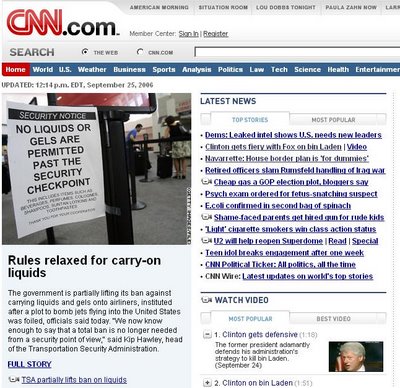
The first five "Top Stories" are all reporting liberal attacks on conservatives as undisputed fact.
Yeah, right.
The really bizarre thing is that Clinton went on to suggest that the media never asks the Bush administration about their failures. What planet is he living on? The media CONSTANTLY pounds Bush, Rice, Rumsfeld, and the rest of the Administration with hardball questions about real and imagined shortcomings. That is their job, and Clinton's treatment is a cakewalk compared to the grilling that Bush gets.
If there is any question about the existence of a liberal bias in the media, take a look at the headlines on cnn.com yesterday:

The first five "Top Stories" are all reporting liberal attacks on conservatives as undisputed fact.
"But the media is owned and controlled by big, rich Republicans and it does their bidding."
Yeah, right.
Thursday, September 21, 2006
World leaders on GOP speaking tour
(2006-09-21) — The Republican National Committee (RNC) today offered to fund a coast-to-coast U.S. speaking tour featuring Iranian President Mahmoud Ahmadinejad and Venezuelan President Hugo Chavez, in the weeks leading up to November’s Congressional elections.
The offer comes in the wake of two days of public remarks by the two foreign leaders before the United Nations, the Council on Foreign Relations and U.S. news media. Their diplomatic pronouncements included…
· denying the Holocaust
· calling the U.S. president “the devil“
· praying at the U.N. for the return of Islam’s fabled 12th Imam
· praising Cuban dictator Fidel Castro
· insisting any nation has the right to develop nuclear technology
· portraying the United States as the locus of evil in the modern world
· plugging Noam Chomsky’s book “Hegemony or Survival: America’s Quest for Global Dominance.”
“President Bush can talk about his national security plan and foreign policy all day long,” said an unnamed RNC spokesman, “But no one makes a more compelling case than the duo of Mahmoud and Hugo. We want to make sure every American has an opportunity to hear these important world leaders.”
The Republican source said sponsoring the pre-election Ahmadinejad-Chavez speaking tour was also a way of “reaching across the aisle to help our colleagues in the Democrat party to get their message out, so the American voter can make an informed decision.” However, he noted that the keynote speakers had not yet accepted the invitation, saying that they were still weighing offers to work as speech-writers for Nancy Pelosi, the San Francisco Treat.
The offer comes in the wake of two days of public remarks by the two foreign leaders before the United Nations, the Council on Foreign Relations and U.S. news media. Their diplomatic pronouncements included…
· denying the Holocaust
· calling the U.S. president “the devil“
· praying at the U.N. for the return of Islam’s fabled 12th Imam
· praising Cuban dictator Fidel Castro
· insisting any nation has the right to develop nuclear technology
· portraying the United States as the locus of evil in the modern world
· plugging Noam Chomsky’s book “Hegemony or Survival: America’s Quest for Global Dominance.”
“President Bush can talk about his national security plan and foreign policy all day long,” said an unnamed RNC spokesman, “But no one makes a more compelling case than the duo of Mahmoud and Hugo. We want to make sure every American has an opportunity to hear these important world leaders.”
The Republican source said sponsoring the pre-election Ahmadinejad-Chavez speaking tour was also a way of “reaching across the aisle to help our colleagues in the Democrat party to get their message out, so the American voter can make an informed decision.” However, he noted that the keynote speakers had not yet accepted the invitation, saying that they were still weighing offers to work as speech-writers for Nancy Pelosi, the San Francisco Treat.
Wednesday, August 02, 2006
The cost of financial planning
I have a lot of friends who are smart, knowledgeable, and generally wise in the decisions they make. However, a lot of them have one common characteristic. They don't actively plan their financial future.
Some do nothing at all. They don't budget, don't save, don't invest, and don't even take advantage of the 401k plan offered by their employer. I don't have very many friends in this category, but they are in the worst shape for the long term. Their future security will be at the mercy of Congress as the demographics puts a squeeze on the liquidity of Social Security and Medicare.
Others put away a little bit of money in their 401k. That will help them some, but they have no idea if it will be enough. In addition, they don't usually have a strategy to their investment selections. They could allocate their funds better inside the 401k plan, but they don't really know how. These people are gambling with their future. They may be saving too little, and be forced to work much longer than they wanted to, or to retire at a much reduced standard of living. Alternatively, they may be saving too much, needlessly constricting their budget now so that they can die sitting on a pile of money. They may also be paying a high opportunity cost for failing to more effectively invest their money. Many are taking unnecessary risks by investing in company stock or by not diversifying enough.
There is a third category of people. They recognize the importance of financial planning and don't feel up to the task of doing it themselves, so they hire a professional financial planner. This may help them to avoid some of the pitfalls, but at a very high cost. Unfortunately, the commission-driven world of financial planning brings its own set of pitfalls. There are some "fee only" planners who will provide good advice and sound management at a reasonable cost, but most of the industry is commission-based, and the planner's interests are not at all aligned with the interests of the customer.
These financial managers are not so much "planners" as salesmen, and they want to sell the product which gives them the highest possible commission, not the product which best meets the client's needs. Layer upon layer of fees and expenses eat into the client's principle and stunt the growth of the investments. A typical "financial planner" charges a management fee of 2% of assets under management. Then he invests in mutual funds with a 5% front load and 2% annual expenses. The underlying investment would have to return 10% in the first year for the client to just break even. You could do better with a bank CD.
Over the long term, how much impact does a 2% management fee have on your savings? As an example, consider Steve, a 25-year-old who earns $40k per year. Steve invests 10% of his income in a Roth IRA. Each year he gets a 4% raise, which is just slightly more than inflation. If his investments return 8% annually, by the time he is 65 years old, he will have accumulated $1,846,942. Not bad. However, if Steve had used a financial planner who charged a 2% management fee and invested in front-loaded mutual funds, his account would only be worth $1,122,862. The planner would have gradually transferred 40% of Steve's life savings into the planner's bank account. This is the difference between a secure, comfortable retirement and a job as a Wal-Mart greeter at age 78.
The sad thing is that financial planners don't do much to earn these high fees they charge. Most use outdated and overly simplistic "rules of thumb" to decide how much you need to save and how you should invest. A financial planner's livelihood depends on convincing you that he has a magic crystal ball which lets him pick better investments than you could pick on your own, and that this "value added" will more than make up for his "industry standard" fees. The facts tell a different story. More than 75% of financial planners' accounts underperform the S&P 500 index. About half underperform a "moderate allocation" index consisting of 70% stocks and 30% bonds. In other words, you could randomly select a mutual fund and have a 50/50 chance of doing better than your planner. Better yet, you could buy the Vanguard Total Market Index and have a 75% chance of outperforming your planner.
Right here on this blog I am going to present a plan which for Steve could make the difference between $1,846,942 and $1,122,862. This plan, worth roughly three quarters of a million dollars, is provided free of charge. I have no financial stake in any of the products that I name. I am only a satisfied customer of these companies.
Start off by reading The Four Pillars of Investing by William Bernstein. The $18.87 price at Amazon will make you more effective at managing your finances than many professionals who charge hundreds of dollars a month.
Read Scott Burns column. Read his archives. Read his sections on consumption smoothing, couch potato investing, indexing, Club 401, portfolio survival, and his "Seven Laws of Personal Finances".
Get familiar with Morningstar.com, a great source of data on mutual funds.
Know your own risk tolerance and don't exceed it.
Understand the different categories of risk affecting your finances.
Understand some important concepts such as the relationship between risk and reward, compounding interest, dollar cost averaging, diversification, time value of money, and Modern Portfolio Theory.
Make a budget. Any sound financial plan starts with living below your means. Start by tithing to your local Church. Then set aside money for savings. Next pay your fixed expenses. Finally, allocate what is left for other expenses and discretionary spending.
Use ESPlanner to develop a comprehensive financial plan for your family. This powerful tool developed by Laurence Kotlikoff, Professor of Economics at Boston University and Research Associate at the National Bureau of Economic Research, is light-years ahead of what the financial planning industry uses. ESPlanner uses the concept of consumption smoothing combined with dynamic programming to create an optimal lifelong plan, considering all aspects of your finances: current and future earnings, future expenses, housing expenses, home mortgage, taxes, social security, life insurance, and contingency plans for events such as the death of a spouse. Read this paper for a full description of ESPlanner. If you balk at the $150 price tag, compare it to how much you might pay for less reliable help from the financial industry, or to the cost of botching your financial plan.
Use term life insurance to provide the coverage as recommended by ESPlanner.
When you invest, don't chase past performance. Last year's hottest fund is not likely to outperform in the future. Instead, use a consistent asset allocation built with low-cost no-load index funds focusing on total portfolio performance rather than individual funds. Many managed funds charge annual expenses of 1.5% or higher, and you are right back where you started with the financial planner, so mind the expenses. Vanguard offers many funds with expenses below 0.3%. You can get adequate diversification with a fairly small number of funds. Principles from the reading suggested above will help you select an appropriate asset allocation. I like a mix of domestic and international stocks with a tilt towards value and smaller company stocks. The overall risk/return level can be adjusted by combining stock with fixed income investments.
Don't try to time the market. In fact, don't pay too much attention to the day-to-day ups and downs. Reacting to short-term market movements will almost always cause you to make bad decisions. Instead, pick an asset allocation which is appropriate to your goals, and stick with it. If your investments start to drift from that allocation too much, rebalance back to your target allocation, but otherwise keep your hands off. Automatically contribute to your investments on a regular basis, as recommended by ESPlanner.
Ignore any magazine article with a headline such as "Hottest 10 mutual funds" or "Top Stocks to Make You Rich". This is worthless information because past results do not indicate future performance. Professional managers of institutional accounts with hundreds of millions of dollars under their management, an army of analysts, and far greater resources than you have work around the clock to identify and exploit information which will give them an edge. Do you really think that you can beat them at their own game?
If your employer offers a 401k, use it. Contribute at least as much as your employer will match. If a 401k is not an option, consider a Roth IRA or other tax sheltered retirement accounts. Fit the 401k into your overall asset allocation strategy.
If you have kids, open a 529 account to save for their college expenses. A 529 account allows you to contribute up to $10,000 each year to each child. If you start early, this is way more than you need to contribute. Your child is the beneficiary, but you retain ownership of the account. The money grows tax free and can be withdrawn to pay qualified expenses (tuition, books, fees, room and board) tax free. If you withdraw the money for any other purpose you will pay a penalty on the growth. We use the T. Rowe Price College Savings Plan, but Vanguard also offers a good plan.
I didn't say that it was simple. It takes some time and effort to get started. But once you do, you can be a lot better off than you would be otherwise.
Some do nothing at all. They don't budget, don't save, don't invest, and don't even take advantage of the 401k plan offered by their employer. I don't have very many friends in this category, but they are in the worst shape for the long term. Their future security will be at the mercy of Congress as the demographics puts a squeeze on the liquidity of Social Security and Medicare.
Others put away a little bit of money in their 401k. That will help them some, but they have no idea if it will be enough. In addition, they don't usually have a strategy to their investment selections. They could allocate their funds better inside the 401k plan, but they don't really know how. These people are gambling with their future. They may be saving too little, and be forced to work much longer than they wanted to, or to retire at a much reduced standard of living. Alternatively, they may be saving too much, needlessly constricting their budget now so that they can die sitting on a pile of money. They may also be paying a high opportunity cost for failing to more effectively invest their money. Many are taking unnecessary risks by investing in company stock or by not diversifying enough.
There is a third category of people. They recognize the importance of financial planning and don't feel up to the task of doing it themselves, so they hire a professional financial planner. This may help them to avoid some of the pitfalls, but at a very high cost. Unfortunately, the commission-driven world of financial planning brings its own set of pitfalls. There are some "fee only" planners who will provide good advice and sound management at a reasonable cost, but most of the industry is commission-based, and the planner's interests are not at all aligned with the interests of the customer.
These financial managers are not so much "planners" as salesmen, and they want to sell the product which gives them the highest possible commission, not the product which best meets the client's needs. Layer upon layer of fees and expenses eat into the client's principle and stunt the growth of the investments. A typical "financial planner" charges a management fee of 2% of assets under management. Then he invests in mutual funds with a 5% front load and 2% annual expenses. The underlying investment would have to return 10% in the first year for the client to just break even. You could do better with a bank CD.
Over the long term, how much impact does a 2% management fee have on your savings? As an example, consider Steve, a 25-year-old who earns $40k per year. Steve invests 10% of his income in a Roth IRA. Each year he gets a 4% raise, which is just slightly more than inflation. If his investments return 8% annually, by the time he is 65 years old, he will have accumulated $1,846,942. Not bad. However, if Steve had used a financial planner who charged a 2% management fee and invested in front-loaded mutual funds, his account would only be worth $1,122,862. The planner would have gradually transferred 40% of Steve's life savings into the planner's bank account. This is the difference between a secure, comfortable retirement and a job as a Wal-Mart greeter at age 78.
The sad thing is that financial planners don't do much to earn these high fees they charge. Most use outdated and overly simplistic "rules of thumb" to decide how much you need to save and how you should invest. A financial planner's livelihood depends on convincing you that he has a magic crystal ball which lets him pick better investments than you could pick on your own, and that this "value added" will more than make up for his "industry standard" fees. The facts tell a different story. More than 75% of financial planners' accounts underperform the S&P 500 index. About half underperform a "moderate allocation" index consisting of 70% stocks and 30% bonds. In other words, you could randomly select a mutual fund and have a 50/50 chance of doing better than your planner. Better yet, you could buy the Vanguard Total Market Index and have a 75% chance of outperforming your planner.
Right here on this blog I am going to present a plan which for Steve could make the difference between $1,846,942 and $1,122,862. This plan, worth roughly three quarters of a million dollars, is provided free of charge. I have no financial stake in any of the products that I name. I am only a satisfied customer of these companies.
Start off by reading The Four Pillars of Investing by William Bernstein. The $18.87 price at Amazon will make you more effective at managing your finances than many professionals who charge hundreds of dollars a month.
Read Scott Burns column. Read his archives. Read his sections on consumption smoothing, couch potato investing, indexing, Club 401, portfolio survival, and his "Seven Laws of Personal Finances".
Get familiar with Morningstar.com, a great source of data on mutual funds.
Know your own risk tolerance and don't exceed it.
Understand the different categories of risk affecting your finances.
Understand some important concepts such as the relationship between risk and reward, compounding interest, dollar cost averaging, diversification, time value of money, and Modern Portfolio Theory.
Make a budget. Any sound financial plan starts with living below your means. Start by tithing to your local Church. Then set aside money for savings. Next pay your fixed expenses. Finally, allocate what is left for other expenses and discretionary spending.
Use ESPlanner to develop a comprehensive financial plan for your family. This powerful tool developed by Laurence Kotlikoff, Professor of Economics at Boston University and Research Associate at the National Bureau of Economic Research, is light-years ahead of what the financial planning industry uses. ESPlanner uses the concept of consumption smoothing combined with dynamic programming to create an optimal lifelong plan, considering all aspects of your finances: current and future earnings, future expenses, housing expenses, home mortgage, taxes, social security, life insurance, and contingency plans for events such as the death of a spouse. Read this paper for a full description of ESPlanner. If you balk at the $150 price tag, compare it to how much you might pay for less reliable help from the financial industry, or to the cost of botching your financial plan.
Use term life insurance to provide the coverage as recommended by ESPlanner.
When you invest, don't chase past performance. Last year's hottest fund is not likely to outperform in the future. Instead, use a consistent asset allocation built with low-cost no-load index funds focusing on total portfolio performance rather than individual funds. Many managed funds charge annual expenses of 1.5% or higher, and you are right back where you started with the financial planner, so mind the expenses. Vanguard offers many funds with expenses below 0.3%. You can get adequate diversification with a fairly small number of funds. Principles from the reading suggested above will help you select an appropriate asset allocation. I like a mix of domestic and international stocks with a tilt towards value and smaller company stocks. The overall risk/return level can be adjusted by combining stock with fixed income investments.
Don't try to time the market. In fact, don't pay too much attention to the day-to-day ups and downs. Reacting to short-term market movements will almost always cause you to make bad decisions. Instead, pick an asset allocation which is appropriate to your goals, and stick with it. If your investments start to drift from that allocation too much, rebalance back to your target allocation, but otherwise keep your hands off. Automatically contribute to your investments on a regular basis, as recommended by ESPlanner.
Ignore any magazine article with a headline such as "Hottest 10 mutual funds" or "Top Stocks to Make You Rich". This is worthless information because past results do not indicate future performance. Professional managers of institutional accounts with hundreds of millions of dollars under their management, an army of analysts, and far greater resources than you have work around the clock to identify and exploit information which will give them an edge. Do you really think that you can beat them at their own game?
If your employer offers a 401k, use it. Contribute at least as much as your employer will match. If a 401k is not an option, consider a Roth IRA or other tax sheltered retirement accounts. Fit the 401k into your overall asset allocation strategy.
If you have kids, open a 529 account to save for their college expenses. A 529 account allows you to contribute up to $10,000 each year to each child. If you start early, this is way more than you need to contribute. Your child is the beneficiary, but you retain ownership of the account. The money grows tax free and can be withdrawn to pay qualified expenses (tuition, books, fees, room and board) tax free. If you withdraw the money for any other purpose you will pay a penalty on the growth. We use the T. Rowe Price College Savings Plan, but Vanguard also offers a good plan.
I didn't say that it was simple. It takes some time and effort to get started. But once you do, you can be a lot better off than you would be otherwise.
Tuesday, August 01, 2006
Booze talking
James Mee, the Los Angeles County sheriff's deputy who arrested Mel Gibson for drunk driving, downplayed the celebrity's anti-Semitic tirade as "Just booze talking". I'm not cutting him that much slack. Alcohol lowers people's inhibitions, causing them to say things which their normal self restraint would have prevented them from saying when they are sober. Alcohol does not change a person's opinions or character. It simply reveals what is inside that we usually don't let out. Unfortunately, this gives credence to Gibson's critics who attacked his film "The Passion of the Christ" as anti-Semitic. While the film did present an unflattering view of the Jewish religious leaders who conspired to put Jesus to death, it must be pointed out that the disciples who defended Jesus and Jesus himself are also Jewish. The Jews are God's chosen people, and those who try to harm them will eventually answer to a power even more fearsome than the Israeli military. In any conflict between the Jews and those who wish to destory the Jews, you will find me firmly on the side of the Jews. Some people will try to conflate Gibson's abhorrent views with Jesus or Christianity. However, one person's views which are entirely contrary to the teachings of Christ and the Christian Church reflect on that person, not on Christ. Perhaps this should be a lesson to the Church not to count on Hollywood to deliver the message that we should be communicating to the people we are in contact with every day.
Wednesday, July 26, 2006
Leaving things unfinished
Ten years ago, on April 18, 1996 Israel attacked Hezbollah in Lebanon. The 16-day operation called "Grapes of Wrath" drew international criticism. As other nations of the world condemned Israel for defending itself against an enemy which exists for the stated purpose of destroying Israel, President Clinton did nothing to support Israel. Instead, he said "I think that it is important that we do everything we can to bring an end to the violence." Clinton proceeded to force a cease-fire on Israel before it had fully eradicated Hezbollah. Israel is fighting this war today because Clinton didn't let them fight it ten years ago.
President Bush, on the other hand, recognizes that it is in the interest of Israeli security, American national interest, and the security of the world for Israel to proceed until the terrorist group is neutralized. This is a perfect opportunity to clean out terror cells before a terrorist state can be established on Israel's northern border. A cease-fire only delays the necessity of dealing with this threat and allows Hezbollah to amass more weapons of terror, making the threat more dire.
The distinction between Clinton and Bush highlights their differing definition of peace. To the left, peace is a cessation of fighting. But the only real and lasting definition is that peace is the prominence of justice. We could end the fighting by forcing Israel into another cease-fire. We could end the fighting in Iraq by pulling out. We could wait until Iran has the nuclear ability to carry out their threats against Israel and America. But if we are to learn from history, we must recognize that ignoring a threat will not make it go away, and putting off a conflict until a latter day only makes it worse.
President Bush, on the other hand, recognizes that it is in the interest of Israeli security, American national interest, and the security of the world for Israel to proceed until the terrorist group is neutralized. This is a perfect opportunity to clean out terror cells before a terrorist state can be established on Israel's northern border. A cease-fire only delays the necessity of dealing with this threat and allows Hezbollah to amass more weapons of terror, making the threat more dire.
The distinction between Clinton and Bush highlights their differing definition of peace. To the left, peace is a cessation of fighting. But the only real and lasting definition is that peace is the prominence of justice. We could end the fighting by forcing Israel into another cease-fire. We could end the fighting in Iraq by pulling out. We could wait until Iran has the nuclear ability to carry out their threats against Israel and America. But if we are to learn from history, we must recognize that ignoring a threat will not make it go away, and putting off a conflict until a latter day only makes it worse.
Saturday, July 22, 2006
What's-his-name
I worked on the algorithm design of the weapons delivery system for the F-16, which last month was used to cut short a meeting of the top-ranking leaders of Al Qaeda in Iraq, including Zarqawi and Sheikh Abd-Al-Rahman. We are proud of the work that we do and of the fact that our product helped an Air Force pilot place a thousand pounds of high explosives on one of the most evil men in the world with pinpoint accuracy.
State of the art software using sensor fusion to integrate all of the systems on an advanced fighter into one lethal weapon is something we understand very well. Arab names, on the other hand, we have difficulty with. We never have figured out how to pronounce the name of Zarqawi's successor, so we have given him a nickname.
We just refer to him as "Next".
State of the art software using sensor fusion to integrate all of the systems on an advanced fighter into one lethal weapon is something we understand very well. Arab names, on the other hand, we have difficulty with. We never have figured out how to pronounce the name of Zarqawi's successor, so we have given him a nickname.
We just refer to him as "Next".
Subscribe to:
Posts (Atom)
